15 August 2006

'Tiser keeps abreast of the times


There's an identity crisis in the Adelaide media, or at least that large chunk of it owned by News Ltd. The Advertiser has recently revamped and renamed its website Adelaidenow (no space between words). This is the only website of the News metropolitan dailies which has changed its name from that of the parent paper. Notwithstanding this, Adelaidenow is offering a free subscription to the (online only) " Advertiser PM Edition" (or "edtition" as the home page describes it ).


Adelaidenow or Advertiser? Is this a marketing exercise designed to gauge the interest in a separate online infotainment daily (which, as Adelaidenow does, can draw its stories from all over the News empire) or is it evidence of in house divisions in the city where Mr Murdoch began his rise to global ascendancy?


13 August 2006

A community event


This week is the hard rubbish collection week in my street. The council gives residents the opportunity to discard unwanted items which are too large to be taken in its regular collections. The items are supposed to be put on the kerb between noon on the Saturday and 7 am of the Monday of the relevant week. What also happened today is that people, both residents and outsiders I'd guess, toured the area looking for items for which they might have some use. I put out a settee and a lounge chair , and they were snapped up by a person further down the street, who in turn put out a floral lounge chair. I've not checked to see if it is still there.

This scavenging, and that word with its negative connoations doesn't seem quite right has become a local custom, and one to which little if any stigma is attached. It gives neighbours something to talk about, and more of them do stop to talk about it and some, such as my next door neighbour, act informally to assist potential collectors. I believe that it provides a modest form of community strengthening: by doing our bit to tidy up our own homes we sometimes even help our neighbours in unexpected small ways.

10 August 2006

Advertisers out of step with reality


As the media, including the BBC , Aljazeera and news.com.au report, air travel to and from UK airports has been disrupted by what the BBC describes as an "airlines terror plot".

A common thread of all reports, supported by references to and pictures of chaos at Heathrow, is that intending travellers should defer travel if possible or otherwise be prepared for long delays and extra security precautions, including restrictions on cabin baggage (which seem to extend to personal reading matter).

As I seek more information on the subject, the advertisers who fasten on to my searches seem oddly inappropriate, to say the least. Here are some example of "sponsored links" (sponsored not by me needless to say):

Airport London Taxi (LHR)Transfer to and from (LHR) Pay a Fixed Price 0870 38 99 777
www.minicabhire.com

Chauffeur London Airports

Luxury Mercedes in South East UK 1st Class Taxis at Great Rates
www.mercury-travel.co.uk

Airport Transfers London

London airport transfers by minibus, chauffeur or coach
conciergedesk.co.uk

Heathrow Flights

Compare cheap flight deals to Heathrow from top airlines.
Heathrow.OneTime.com

08 August 2006

Census: room at the internet


Tonight I completed my census form on the internet. I wouldn't have been surprised had the census website collapsed under the pressure applied by the estimated 1,000,000 others doing likewise, but it didn't. Whether this was because fewer than expected chose this option or because the system had been built strong enough to carry the load, or whether others have had a different experience, I don't know, but I'll give credit where credit is due and say "Well done ABS".


Fourth test snippets


Where there's mucking about there's money

I'm listening to the BBC radio online description of the Headingley England v Pakistan test. Because the game was evenly poised at the start (though is no longer as I type with Pakistan 5/84 at lunch chasing 300+) a good crowd turned up but caught the ground authorities napping.

The BBC invited the Yorkshire secretary to explain why so many people willing to pay 15 quid ($38) to get in had to wait for so long to do so. His explanation was bizarre: each ticket had to be sold individually, and then the stubs reconciled, presumably while the queues inched forward.

I'll be interested to see how widely this bumbling is reported elsewhere in the British media.

Sun's cricket man gives soccer a boost

In the lunchtime discussion a panel including John Etheridge, the Sun's cricket writer (is "correspondent" too multisyllabic a term for that paper?), ruminated about various matters sporting. In the course of conceding that this northern summer's cricket season hadn't grabbed the public's imagination as last year's had done, Mr Etheridge actually referred to the world game as "soccer". I hope that all the people in Australia who have insisted that the game be called "football" take note.


Mud soup in Guantanamo: on the Cuban side of the wire


Despite my criticism of the practices allegedly condoned by the authorities supervising the US "facility" at Guantanamo Bay I'm not entirely blind to the shortcomings of the Cuban regime on the other side of the wire. Spiegel Online (English version) reports how the regime treats dissidents, for example "
A former detainee of a jail in the Cuban city of Guantánamo recalls that the drinking water was so muddy you had to wait for the sand to settle before drinking it."


07 August 2006

The man who wasn't there


Today's Australian "Cut & Paste" section (p15, not online) prints an excerpt from what appears to be a review on ABC Radio National by Imre Salusinszky of "Honour Bound", a "theatrical performance based on the imprisonment of David Hicks". The excerpt includes these comments

David Hicks doesn't present himself automatically as a subject for these performances. Artists have to accept responsibility for the choices they make, and I think this one is not just out of touch with the Australian community, but somewhat offensive, given what international Islamism has done to us.

We all say that al-Qa'ida is the enemy and we have to flush them out before they kill again, yet we choose this one man, who admits to being in al-Qa'ida and, because he has an Australian passport, make him the focus of protests and petitions and films and plays. There's a great inconsistency here.

Mr Salusinszky did indeed say these words on the arts program The Deep End (audio still available) last Thursday. What
The Australian didn't say (apart from that Mr S is its NSW political reporter) is on the program website: "
Imre Salusinszky hasn't seen Honour Bound as yet - but he's got some strong views about putting the story of David Hicks on stage."

In its arts pages today the paper does print
a review of Honour Bound
"Hicks's jail tale triggers passionate response" by John McCallum, who appeared with Mr S on The Deep End discussion.

It's clear from his descriptions of the action

In a vast steel cage, six performers, choreographed superbly by Garry Stewart, are surrounded by projected texts and video, enveloped in sound and voices, and awash with harsh, shredded light as they fly, hang or turn in the air, crashing against the bars, floor or each other and dance violently, abjectly or tenderly around this frightening, nightmarish space"

that he has actually seen the piece, though he acknowledges that


Because David Hicks has become such a powerful symbol -- a monster, a victim, a terrorist, a martyr, depending on who's talking -- it will anger and upset different audiences for different reasons.

Now that his piece has been mentioned in The Australian I wonder whether Mr S will be clarifying that he didn't see the performance. Somehow I doubt it.


04 August 2006

Stop it, you'll go bland


Today in Spiked Frank Furedi explores the event to be held in London tomorrow which will bring into the open (and to the nation's television screens) a practice which has hitherto been " associated with sad old men wearing dirty raincoats".
He continues "now it is no longer seen as a sordid exhibition, but rather as an exercise in raising awareness about safe s-x." In keeping with the best traditions of political correctness doing drugs, drinking alcohol and smoking will be forbidden, while the event will be open to "people of both genders and s-x-al orientations", though people who exhibit "prejudice, disrespect and intolerance of other people" will be blackballed, ...er... sorry, asked to leave. Libertarians need not completely despair: fully clothed people will not be allowed into the rooms set aside for the competition.

What is this practice? If you've not deduced the answer already, read the article.

Levity aside, Furedi makes many pertinent points, not just about the subject of tomorrow's event. Take this for example:

In recent decades, intimate relationships between people appear to have become more complicated. The expectation of failure and of instability surrounds the institution of marriage, even of cohabitation. It is now common for people to approach their private relationships with a heightened sense of emotional risk. Popular and academic culture contributes to this process: it helps to legitimise our insecurities regarding the possibility of finding love and experiencing fulfilling and passionate relationships.

Today’s ‘therapy culture’ transmits clear signals about ourselves and our attachments to others. We are continually instructed to attend to our own needs in order to fulfil ourselves. Even happiness is discussed as a problem if its realisation depends on others. Indeed, feelings that distract individuals from the goal of self-fulfilment are often defined in negative terms. That is why in many self-help books the feeling of love, especially of the intense and passionate variety, is treated as a problem. Although love is portrayed as the supreme source of self-fulfilment, it is also depicted as potentially harmful because it threatens to subordinate the self to another. The passionate feeling of love towards another person is represented as destructive and dangerous.




03 August 2006

Gratuitous comments about community standards


In today's Crikey (not online) Misha Ketchell reports that The Age's policy of reimbursing the cost of meals consumed by its restaurant reviewers no longer extends to the reimbursement of gratuities paid by the said reviewers.

After pointing out that The Age is the odd person out in the Fairfax media in this respect , he goes on to argue that in Australia there is a "community standard"of a "modest tip, usually of between 5 and 10%.
To unilaterally absolve oneself of this obligation is a bit like declaring you're no longer obliged to stand up for the elderly on public transport."

IMO this is balderdash: the Australian practice, custom, community standard, call it what you will, is that tipping in restaurants is not obligatory, though it may be voluntary eg where a higher standard of service than expected has been provided , or where a group of people have chipped in to cover the cost of their meal and there is some change left over. If tipping is accepted as a "community standard" we won't be far away from the situation common in UK, and perhaps other countries, where an "optional" or "discretionary" service charge (in my limited experience usually 12%) is added to bills.


02 August 2006

Britain doesn't waive rules on rubbish


The UK Daily Mail has recently reported some bizarre examples of the British nanny state in action.

They include instances of children arrested for climbing a tree and cautioned for playing hopscotch in the street.

The authorities have also not gone soft on adults who break the increasingly prescriptive laws.
Putting rubbish out early is now an offence, while residents who fail to prevent local fauna from disturbing their rubbish or who put junk mail in a public rubbish bin instead of their domestic one have been threatened with fines.

At least a small measure of commonsense seems to have prevailed in the case of the woman who was
charged with
putting her rubbish in the wrong bin : she was acquitted after refusing to pay the fine.

I try to do the right thing with my waste, which is put into wheelie bins for collection, but I'll be even more vigilant now in case my local council tries to enforce crackbrained rules like these.

01 August 2006

Farewell VHS movies


Today I culled my collection of VHS movies and consigned most of them to the bin to await tomorrow's collection.

I've already replaced many of them with DVD copies, which take up less space and are easier to operate. I particularly like those with extras such as directors' commentaries and English for the hearing impaired subtitles (my hearing's not bad enough to qualify for the DSP but I occasionally miss a muffled comment or two).

I'm always on the lookout for new DVD releases (and rereleases), both local and international, though I'm annoyed by regional coding(what's happening to it under the Aust-US Free Trade Agreement?) which puts barriers in the way of Australians who want to buy DVDs available elsewhere.

I'd also like to see more reviews of DVDs in the media. The SBS Movie Show has IMO been unfairly terminated but its ghost lingers, at least for the moment, on the program's website. ABC TV's otherwise worthy At The Movies doesn't deign to review DVDs, which leaves the local street mag Rip It Up and Lawrie Zion's "Letterbox" column in The Weekend Australian as my principal sources of information on new DVD releases. Unfortunately neither the mag's reviews nor Lawrie's column are online.

Last weekend's, Lawrie asked his readers to nominate movies which aren't available on DVD, either because they've never been released or are no longer available. A brief look at IMDb will reveal many films, eg the Charles Chauvel Australian movies Jedda and Sons of Matthew and world cinema greats such as Satyajit Ray's Charulata , which are not available in that format, even though many of them are or have been available on VHS.

I'll be getting in touch with Lawrie and adding my five cents' (or more) worth. If you have your own suggestions you can contact him at lawrie.zion@bigpond.com


30 July 2006

Matildas lose in yet another penalty shoot out


In the final of the women's soccer Asian Cup China has defeated Australia (the Matildas) in yet another penalty shoot out. While the game seems to have been played in a good spirit, unlike the semi-final between China and North Korea , IMO once again the way the result was achieved shows the limitations of the inherently low-scoring sport which is soccer/football. Surely someone can come up with a better idea? What about suspending the off-side rule if extra time is played?


Census time


The local census official came by today with my form, which reminded me that 8 August, the census day (more accurately night), is nigh.

I've seen an ABS TV commercial featuring Ernie Dingo at a Brisbane railway station and a newspaper ad with a message of support from a number of corporations, but otherwise there seems to have been little discussion about the census. I recall that at previous census times there has been a fair bit of discussion about some of the questions asked, and the privacy aspects. Are we now more inured to government statistical gathering, or are there too many other matters preoccupying us at present?

I have one observation: the form is relatively long (18 pages); and one question: how far in advance of census night can you fill it (or parts thereof) in?

29 July 2006

Tram extension to run ring around inner city


Adelaide Now (the revamped Advertiser/ Sunday Mail website) has a photo of Ministers Conlon (Transport) and Lomax-Smith (Tourism, City of Adelaide et al) announcing the extension of the Adelaide- Glenelg tram line to an as yet undetermined ring route (a couple of options are outlined) around the inner city.

Not surprisingly, and not without some justification , Minister C has come out fighting and attacked "small-thinking " critics of the proposal, which is estimated to cost $31 million. The small thinkers aside, the Minister's problems with his handling of the Transport portfolio have been further exacerbated by a dispute over the purchase of two 15 year old buses from Brisbane. As the effective life of a bus in Adelaide is deemed to be 25 years by this standard there's some service left in these acquisitions, but I wonder how good the oversight of our public transport system is if we have to rely on non-airconditioned, non-wheelchair accessible hand me downs. How many 25 year old cars are still running on our roads?


28 July 2006

The Australian Foreign Legion(s)


I expected more media comment about the matter, but only Michael Pascoe in Crikey (not online) of those I've read draws attention to the different official and media attitudes to two Australian citizens: Asaf Namer, who was killed while on active service with the Israeli army (he was also an Israeli citizen); and David Hicks, who continues to languish in Guantanamo Bay.

Sgt Namer's death, like every other one in the present undeclared war, is regrettable, yet it has brought to light that, according to the Sydney Morning Herald, "
dozens of Australian soldiers serving in the Israeli Army and hundreds who are eligible to be called up for compulsory reserve duty".

The story headline "Serving here is part of our Australian heritage" raises some very interesting questions, including what mght happen if and when, as News.com.au reports, a UN peacekeeping force including Australians is formed and it meet s Australians serving in the Israeli army. The RSL might have a view about Australian citizens serving in the armed forces of a foreign country, even one to which we are not unfavourably disposed. It does set a precedent for future situations. How many Foreign Legions will Australian citizens be allowed (or encouraged) to serve in?


Update 29 July

Today's Weekend Australian has an article"Aussie passed up desk job for front line" and several letters reflecting a variety of perspectives about Sgt Namer, including one drawing a comparison with the Hicks situation. The article refers to "
Australian-Israeli army spokesman Guy Spigelman", an ambiguous though not inaccurate description , who confirmed that "more Australian-Israeli dual nationals could be called up to fight in the war, with between several dozen and 100 already on active service in the Israeli Defence Force."

This was juxtaposed with a comment from the (Australian) Prime Minister who "said he did not have a problem with Australian dual nationals fighting for Israel because they were fighting for that country's armed services. But he said if Australian citizens attempted to fight for Hezbollah they could be breaching the law. " Perhaps Mr Howard should clarify the first part of his statement in case it comes back in another context to bite him. As for the second part The Age reports that the PM is awaiting further advice to see whether, because Hezbollah is banned under our counter-terrorism laws, Australian citizens who fight for it are breaking the law.

The Age also reports that Attorney-General Ruddock expects David Hicks to be put on trial "soon", a claim which is taken with a pinch of salt by David McLeod, Hicks's Adelaide based lawyer. The paper also prints several letters on the Lebanon situation in general and the foreign enlistment aspect in particular.


25 July 2006

Death in the workplace not an industrial accident?


Today I heard ABC Radio News report the death of a man working at the Adelaide Brighton Cement works at Birkenhead, near Port Adelaide. Unfortunately the ABC news website did not report it. Adelaide Now , the new name for The Advertiser's revamped website, mentions it briefly, describing it as "an industrial accident" with "no suspicious circumstances".

The fullest description online comes from Indaily TheIndependent Weekly's daily email news service. The headline "Contractor crushed to death by truck at cement plant" is a succinct summary which is fleshed out by a report including the chilling statement that "Police will prepare a report for the state coroner because the death was not deemed an industrial accident".

If this was not an industrial accident, then what was it? Surely anyone who is killed or injured on a worksite while undertaking work connected with the workplace should be counted in the statistics of industrial accidents. If the law says otherwise then, at least in this situation, the law is an ass. I offer my condolences to the family and friends of the deceased.


23 July 2006

Where the.....are you?


The Weekend Australian Magazine has announced the winners of the "Wish You Were Here" photographic competition which it has been running in conjunction with Tourism Australia.

The photos of the winners and finalists can be seen here.

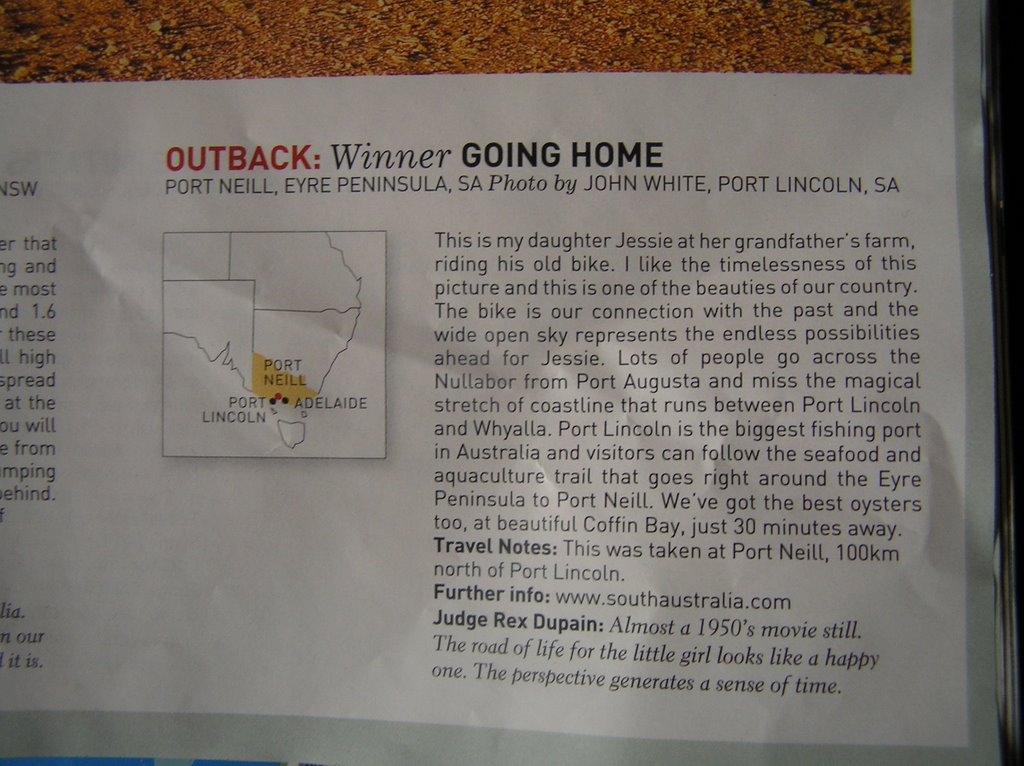
The winner of the Outback category was a photo taken in Port Neill, South Australia. The paper has published the four winning entries together with a caption and location map for each. The map purporting to show Port Neill's location is almost unbelievably erroneous. First, South Australia is confused with Victoria, then Port Neill is placed at the head of Port Phillip Bay (ie where Melbourne is), with Port Lincoln located in the vicinity of Geelong, and Adelaide marked as a south eastern suburb of Melbourne/ Port Neill.

Fortunately the map doesn't appear on The Australian or Tourism Australia's websites. In case you can't get hold of a copy of the paper to check that I'm not pulling your leg, I've taken a snapshot of p27 showing the map and caption.

I wonder whether, and if so from whom and when, we will see a correction. The photographer has, like the other three winners, won a luxury holiday and a new camera, but deserves better than this.

22 July 2006

"We learn from those with whom we disagree"


In yesterday's Australian Frank Devine discusses the views presented by Owen Harries, who supported Australia's involvement in the Vietnam War but who has opposed its involvement in Iraq. Devine's position on each is the opposite of Harries's. Apart from the substance of the two arguments it's unusual these days to see one person criticising another's views so politely. Perhaps it's easy for me to say this because I agree with parts of what each of them says, even if I'm more inclined to agree with most of Harries's seven points (read the transcript for yourself t see them).
As Devine, quoting Geoffrey Blainey, acknowledges "we learn from those with whom we disagree".

One media organisation, two views


Posting on the BBC's The Editors blog Richard Porter reflects on two quite different versions of the BBC midday news coverage on Thursday of the evacuations from Lebanon. One, BBC World (Mr Porter's department), focused on the international aspects of the evacuation and drew attention to "a
rising chorus of experts who have raised the question of international humanitarian law". The other, the domestic BBC News 24 channel, depicts the evacuation through Union Jack-tinted spectacles: there is no indication that nationals of other countries were also seeking evacuation.

Porter comments


It's a great thing about the BBC that we have sufficient editorial independence to be able to make these decisions. Both, in their own way, are very focused on the audiences served by the programmes. Neither (in my view) is more correct than the other.

This blandness raises more questions than it dodges. While the BBC does have, as he later states, an obligation to keep British citizens informed of the evacuations, focusing so closely on the British perspective makes it harder for the listeners to get a feeling for the context in which they are taking place, and may in consequence increase rather than allay fears.

Fortunately, like the good BBC person he no doubt is, Porter recants a little at the end of the post:

The challenge for us - whether we be serving domestic or international audiences - is not to lose sight of all the issues. It's complicated; it's changing rapidly; opinions are strongly-held on all sides and need to be properly reflected. So even if we spend a few hours of one day focusing on one aspect - such as the British evacuees - we must make sure that over time we keep coming back to the core questions. What's happening now? What caused this? What's going to resolve it? And many others...


This is a good summary of why I turn to the BBC so often as a major source of my international news.


20 July 2006

An almost overlooked anniversary


To its credit The Australian recently published an article by Ross McMullin on the Battle of Fromelles, "the worst 24 hours in Australian history" , as he described it.

An extract:

On July 19, 1916, Australian soldiers participated in their first significant operation at the Western Front, near the French village of Fromelles. It was a disaster, with 5533 Australians becoming casualties in one night. Our casualty toll at Fromelles is equivalent to our total casualties in the Boer War, the Korean War and the Vietnam War put together.

It was not just the worst night in Australian military history. Tomorrow [19 July] is the 90th anniversary of the most tragic 24 hours in Australia's entire history.

The Fromelles fiasco lacked the slightest redeeming tactical justification. It was conceived as a feint. The idea was to deter the Germans from transferring units from Fromelles to the Somme. But the plan was gravely flawed.