26 May 2006

New York highlights


Three days isn't quite enough to grasp the flavour of NYC, but here are my recommendations:

- Central and reasonably priced accommodation (by US standards ie less than $US 250 a day) is available and maximises the time available for sightseeing etc.

- Empire State Building gives an excellent overview (literally) of the bottom half of Manhattan Island and nearby landmarks such as Liberty and Ellis islands.

- A Manhattan island cruise gives an excellent ground level view of the island. I took the full island cruise with Circle Line Cruises which was excellent especially because of the views, the commentary and the six dollar bottomless mug of coffee/ chocolate sold on board.

- Museum of Modern Art

Needs more than one visit to even start to do justice to its collections.

- Natural History Museum

Good, but I was perplexed because I couldn't find the exhibit of the the giant squid and the whale fighting each other which was featured in (and gave the title to) the recent movie The Squid and the Whale.

- Staten Island ferry

A one hour free round trip which passes close to the Statue of Liberty and Ellis Island (though not as close as the Circle Line cruises) .

- Ground Zero

Worth a visit just to see the site: not only how much was destroyed and but also how so many buildings nearby were spared - check out the adjoining St Paul's Church with its almost intact graveyard and flower beds.

- Brooklyn Bridge

If possible walk across it from Brooklyn towards Manhattan and its skyline.

- Walk as much as possible (there aren't any steep hills) and use public transport when you need to move more a than a kilometre in a short time: $US7 buys an all day pass for the subway (which extends well beyond Manhattan Island) and the buses.


25 May 2006

The longest day of my life

On May Day I left Adelaide at 6.40 am local time and arrived in New York at 5.20pm local time the same day. By my calculation this meant that for me 1 May 2006 lasted 37.5 hours, as Adelaide time is 13.5 hours ahead of NY time.

08 May 2006

London

I'm now in London, having travelled via New York, where I spent three full days sightseeing. I'll have more to say in another post.

Today London is quintissentially London: overcast with intermittent rain, but by no means too cold to get out and about, which I plan to do shortly.

30 April 2006

Latest US word on Guantanamo Bay


Under the headline "U.S. Says It Fears Detainee Abuse in Repatriation" the New York Times reports

A long-running effort by the Bush administration to send home many of the terror suspects held at Guantánamo Bay, Cuba, has been stymied in part because of concern among United States officials that the prisoners may not be treated humanely by their own governments, officials said.

Administration officials have said they hope eventually to transfer or release many of the roughly 490 suspects now held at Guantánamo. As of February, military officials said, the Pentagon was ready to repatriate more than 150 of the detainees once arrangements could be made with their home countries.

But those arrangements have been more difficult to broker than officials in Washington anticipated or have previously acknowledged, raising questions about how quickly the administration can meet its goal of scaling back detention operations at Guantánamo.

....................................................................................

The military has so far sent home 267 detainees from Guantánamo after finding that they had no further intelligence value and either posed no long-term security threat or would reliably be imprisoned or monitored by their own governments. Most of those who remain are considered more dangerous militants; many also come from nations with poor human rights records and ineffective justice systems.


What implications, if any, are there for Australia and for David Hicks? Read the whole article and wait to see how the issues it discusses are reported in the Australian media.

29 April 2006

Voices of War


Voices of War is a recently published book of 21 extracts from the Australians at War Film Archive, a project which has recorded interviews with over 2,000 Australians who were involved, not always in a frontline fighting capacity, in many wars, conflicts and peacekeeping operations.

The book only scratches the surface of the huge body of interview transcripts, which can be found on the Archive website.

While the project is undoubtedly of major importance some of the transcripts I've read have been very poorly proof read, especially many place names. For an example see this interview
with a South Australian WW2 veteran, where, among other mistakes, Port Noarlunga is transcribed as "Port Malunga", Aldgate as "Mooregate" and a place in the Adelaide Hills is described as "Birdum"(any suggestions as to what this might be? It can't be the former terminus of the North Australia Railway).

The same page also has a photo of what is stated to be members of a platoon of the "2/4th" battalion, which should be "2/48th". Many veterans and others, especially South Australians, would be appalled at this error.

Michael Caulfield, the editor of the book and producer of the associated TV series, acknowledges that the interviewers were overworked and underpaid. Even so it should have been possible to enlist some volunteers, especially some with local knowledge, to assist with editing.

Another issue is addressed in the website

Some of the details recorded here may be distressing to users and family or friends of the persons interviewed. Users should also keep in mind that some materials may contain offensive language, depictions of sexual matters or negative stereotypes reflecting the culture or language of a period or place.

The material presented on this website is the memories and reflections of the person being interviewed. The material is presented in good faith, but does not reflect the considered views of the Department of Veterans' Affairs (DVA) or The Australians at War Film Archive (AAWFA).

Any access that you make of this website is undertaken at your own risk.

I wonder what, if any, say the interviewees had as to what was included or excluded from the transcripts, and whether they gave informed consent to their interview transcripts being put on the web. I'm not not suggesting censorship, but maybe a bit more sensitivity about what has been posted on the website.

Alida Valli


Last week Alida Valli, the renowned European actress, died. Her full name, according to her obituary in the London Times, was
Baroness Alida Maria Laura Altenburger von Marckenstein Freunberg. Her career in films extended over almost 70 years: for details see her IMDb entry.

While her life had many vicissitudes if for nothing else she deserves to be remembered for her role as Anna Schmidt in The Third Man, and particularly for the final scene, as the Times obituarist so aptly describes it:

in one of cinema’s most memorable dénouements, Harry Lime’s girlfriend, Anna Schmidt, played by Alida Valli, walks away from his grave and the soft-hearted consolation offered by Holly Martins, choosing the memory of Lime’s cynical charm instead.

The movie is widely available on DVD. I recommend it highly.


Nothing but ...inconsistent customer service


In the last week I've experienced some very varied customer service.

Australia Post h
ave been running a campaign "Nothing But Savings", with a brochure delivered to both my home (despite a "no junk mail" sign on the letter box) and my PO box (I don't know if it's possible to block junk mail to PO boxes), which offered, among other things, Olympus xD picture cards at a good price.

I went to Norwood PO and asked for one, only to be told "we don't have them, you'll have to go to a larger outlet". The counter clerk suggested that I should try in the CBD but otherwise made no effort to ascertain which, if any, other POs had the item available.

Next stop the CBD where, after a long wait in the queue at the City Cross PO, I was told by the clerk who served me that they had had none of the memory cards left. She did however take the trouble to locate some other POs which did have stocks (and this apparently required her to make phone calls rather than to consult an online database).

The contrast between the standards of service at the two outlets was amazing. What, if any, records does Australia Post keep of the stock at its outlets and what minimum standards of customer service does it expect from its staff?

The brochure did state "Not all products available in all outlets, limited stock, while stocks last" and invited people to visit the website www.auspost.com.au, but the website has nothing about the promotion let alone about which outlets hold stock of which items.

All this contrasted with my dealings with Dick Smith Electronics, who maintain a detailed database on their excellent website. From this you can obtain information about products, locate which stores have them in stock and how to order items online if that's your preference . Unlike Australia Post the standard of customer service is of a uniform high standard (if they don't have an item in stock they'll usually be able to get it for you), which gives me confidence to make them my first port of call for my electronic needs.


Slipping from Dizzy heights


Jason "Dizzy" Gillespie, having just made 201 not out for Australia in a test match against Bangladesh, returned home to Adelaide, turned out for his club side in the final and, batting in a tight situation, was dismissed for a duck.

Does this tell us anything about the relative standards of Adelaide district cricket and test matches involving Bangladesh, or is it only yet another example of the unpredictability of cricket?


25 April 2006

Anzac Day


As usual on Anzac Day, the print media produced several pieces attempting to define what Anzac Day might (not does or should)mean to us now. One of the better ones was in in The Australian where Peter Ryan recounted a story from his war service which, when as he recollected it in relative tranquillity, produced a very different view of the fighting in New Guinea.

From the general point

The central meaning of Anzac Day is commemoration of the service and sacrifice of our warriors over several generations. This is a solemn rite, a time for hushed voices and private thoughts. The Returned and Services League rightly insists that the march be decorous and respectful. But to discourage the participation of veterans' descendants simply guarantees Anzac Day will fade away, and sooner rather than later.

he moves to a description of a specific incident which took place on or near Anzac Day 1943, which I invite you to read for yourself.


22 April 2006

SBS documentary ruffles Turkish feathers


Tonight SBS TV screened a documentary on the Armenian Genocide, a large scale killing, chiefly in 1915, of Armenian citizens of the Ottoman empire by Turks.

I was surprised to see that SBS put a disclaimer at the end of the program and also on its website:

SBS will be screening The Armenian Genocide at 7.30pm AEST, Sat 22 April. After the program, have your say on the documentary here. The producers of the program acknowledge that there is controversy and debate surrounding the historical record of events.

Author Addison Whithecomb's advice may be an apt reminder to forum members:

"When you resort to attacking the messenger and not the message, you have lost the debate." :


IMO this was unnecessary as I don't see why we should have to walk on eggshells to avoid giving offence to those who disagreed with the view presented in the program.

I submitted this to the forum:

I was surprised to see the comment at the end of the program about some of the information presented possibly being disputed by Turkish people. They may feel that their position was not presented as they'd have liked, but so what? Many other contentious matters are discussed in the media without an automatic right of reply bring given to those who feel aggrieved.

I'm of northern European descent as far back as I can tell, so have no emotional involvement in the matter, but what I've read, including Samantha Power's "A Problem From Hell", Orhan Pamuk's "Red" and Robert Fisk's "The Great War for Civilisation", is enough to convince me that especially in 1915, the Turks killed large numbers of Armenians. Some images shown and some statements read in the documentary reinforced my views, which is not to say that I believe that Turkish people of today should have to bear a burden of guilt forever and a day: an acknowledgement that bad things were done would be a good next step for them to take.


For some unexplained reason it has not yet been published.

21 April 2006

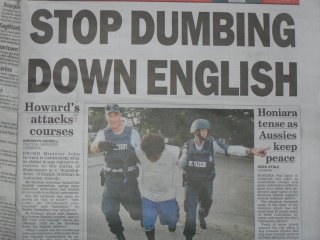
Howard family members support traditional English syllabus but Murdoch paper lets the side down


Here is a photo of the front page of today's Advertiser.

Note the sub-heading under the lead story with what may be a greengrocer's apostrophe attached to the PM's family name.

This solecism is not still on the website (if it ever was), but the text of the article by Bronwyn Hurrell is.

To me, reading between her lines (or should I say "deconstructing her text"?), at one point she seems to be implying that Mr and Mrs Howard are of one mind on these matters, and that that mind is Mrs Howard's, not the PM's:

Mr Howard, whose wife, Janette, is a former English teacher, said he felt "very, very strongly" about the criticism "that we are dumbing down the English syllabus".

Apart from this Ms Hurrell has rounded up a range of opinion from many of the usual local suspects, not all of whom are models of lucidity. For example Professor Reid of the University of South Australia mixes his metaphors (or cliches) "Every time there's the slightest change in education, it's a kneejerk response of accusing educators of dumbing down", while a "spokesman" for the education department

said SA "supports a curriculum that teaches reading, writing, grammar and communication and uses a range of texts, including traditional literature. It is vital that the enjoyment and value of reading is promoted to students."

See anything wrong with the last sentence?

This shows that, notwithstanding my suspicion of the PM's motives for raising the matter I have some sympathy for the Howards' (should it be Howards's?) position.

Anyway, for a more balanced view than theirs, read David Williamson's piece in Crikey. The first two paragraphs sum up his view:

I think John Howard's position is too absolutist, but being concerned about the way literature appears to be being taught is legitimate. In the mid-nineties I penned a satire directed at the excesses of postmodern literary theory called Dead White Males. It was a big box office success but drew the wrath of postmodern academics like the ones I had satirised.

I was accused of being deeply conservative and not understanding that the human consciousness is formed and controlled by the ideologies contained in "texts". The theory posited that so called imaginative fiction was no more than ideology promoting the national, class, race and gender positions of the author. What annoyed me about such a smug analysis was not that it didn't contain SOME truth, but that it was being taught as if it was a TOTAL truth.

Peter Craven in The Age also thinks along similar lines:

YOU don't have to agree with the Prime Minister about much else to think that he's on the side of the angels on this one.

"Postmodern" gets used to mean a lot of different things, but the worry that John Howard is reflecting (whether he understands it or not) is based on the postmodernist notion that everything is relative, that there is no aesthetic value that's not illusory, and that our kids might as well be studying any old aspect of pop culture — episodes of Neighbours, cartoons, you name it — rather than King Lear or the poetry of Keats.

Now, there's nothing necessarily wrong with people studying (preferably in media courses) the things they're going to entertain themselves with, but when it comes to literature, it's important that we hang on to the idea that some pieces of work have got more going for them than others.

It's crucially important that we don't lose our sense of the value of the literary classics. This doesn't have to be inert or set in stone. And, of course, we can only read Shakespeare or Joyce or whatever it is as people living now, but that shouldn't delude us into thinking that one thing's as good as another.


Posted by Picasa

Diabolical

From yesterday's Age p22, appropriately in the "Mind Games" section.
Today the problem cum solution grid was reprinted at p16 as "Yesterday's solution".


Posted by Picasa

20 April 2006

A very modern model of a postmodernist Prime Minister


Today Mr Howard waded into the debate about English teaching in Australia with some
trenchant comments:

"I share the views of many people about the so-called postmodernism ... I just wish that independent education authority didn't succumb on occasions to the political correctness that it appears to succumb to," he said.

"We all understand that it's necessary to be able to be literate and coherent in the English language, we understand that it's necessary to be numerate and we also understand that there's high-quality literature and there's rubbish.

"We need a curriculum that encourages an understanding of the high-quality literature and not the rubbish."

But the Sydney Morning Herald online puts the PM on the back foot by quoting Professor Margaret Sankey of the University of Sydney, who asserts that the PM's "moral relativism makes him postmodern":

"He takes lots of different moral standpoints on different occasions. It would be very hard to work out what his particularly moral unitary approach was, because there are core promises and non-core promises," Professor Sankey said.

"There's a lot of shading and ducking and weaving."

Professor Sankey said she didn't understand what Mr Howard meant when he criticised postmodernism in the classroom on ABC Radio in Brisbane earlier today.

"I'm at a bit of a loss to understand why he is saying that. I would really think between you, me and the gatepost that he didn't know what he was talking about."

But she said she didn't want to prejudge Mr Howard.

"I wouldn't like to presume what he knows; maybe he's a covert literary theoretician."

I'm intrigued by the black and white-ness of the PM's distinction between "high quality literature" and "rubbish". I'd like him to give some example of each and to indicate which of them he's actually read (or in the case of plays, seen performed).

George Orwell once wrote about an intermediate category called "good bad books". I'm sure most readers would be able to compile their own lists of books which fit somewhere in this grey area.


18 April 2006

English cricket season begins with old head leading MCC to defeat


Nottinghamshire, last year's Division 1 champions, have just defeated the MCC by 142 runs in the traditional English first class cricket season opener. The score is here.

The MCC team is normally a showcase for promising young players. This year the selectors turned the clock back by choosing as captain John Stephenson ,a 41 year old who played a single test against Australia in 1989. Stephenson batted in the lower order and bowled a few overs at fifth or sixth change (though he did dismiss the last three opposition batsmen cheaply).

In many respects Mr Stephenson seems like an amateur captain from the gentleman and player days, chosen more for his social than his cricketing skills. The match was played at Lord's, so does this mean that he was able to use the amateur dressing room (surely it's still there), and maybe enter the field through a different gate from the rest of his team? Did the Notts players revert to the old custom of giving the opposition skipper one to get off the mark? It seems they may have done so in the first innings, where he made 1, but didn't in the second where he was dismissed without troubling the scorers.

Nottinghamshire also fielded a player who has admitted to using unconventional methods to prepare his spinning fingers for the rigours of bowling.

I wonder whether Shane Warne has ever tried it to assist his delivery?

17 April 2006

News Ltd chooses quiet news day to publish criticism of government


On 12 April a public meeting was held in Adelaide to discuss the situation of David Hicks. The meeting was reported by Channel 9 and ABC's Lateline that day.

Mr Murdoch's local outlet, The Advertiser, has waited five days, until the last day of the Easter long weekend (hardly the busiest news day of the year), to comment by publishing seven letters about Hicks, all of them critical of the government and its
handwashing. They are not available online but you can find them on page 17 of today's paper. Here are some extracts from the letters which were published:

- "Our government of course continues to exhibit a total lack of courage. Bring him home."

- "Guilty or not, we should take care of our own and not leave them 'hanging out to dry'".

- "Hicks might be a 'bad bastard', but he's our 'bad bastard'. More than a cosy e-mail from Minister Ruddock is needed to end this sickening treatment..."

- "Whatever his alleged crimes, David Hicks is entitled to a fair trial."

- "David Hicks is in a position that is a very poor advertisement for democracy and justice...It seems that his worst offence is that he made some stupid choices. For those choices he has been treated worse than a convicted terrorist."

- "Bush, Blair and Howard's combined victimisation of David Hicks knows no apparent bounds. They seem increasingly determined to thrust him through the mincer despite watching a disappointing series of their high-flown but unrealistic legal appeals and whatnot vanish before their eyes."

-"Messrs Bush, Blair and Howard unleashed a war that killed, or led to the killing of, tens of thousands of innocent people. Has David Hicks done anything as reprehensible as this?"

From the 7- 0 score it seems fair to assume that The Advertiser received no letters in support of the government's stand. How many other critical ones did it receive but not publish?

Stories from the outback


Two stories about the outback from the News Ltd website: the first
"Outback survivor or fraud?" casts doubt on a man's claim that he survived 70 days in the desert.

Ricky Megee has told an amazing tale of his 70-day survival in the desert and says a diet of lizards, frogs, snakes and leeches kept him alive.
And Mr Megee, from Toowong, Queensland, has hit out at claims he is a liar.
"People need to understand what I've been through; to have survived out there for so long and then be told I am making it up makes me sick," he said.

Mr Megee said his extraordinary ordeal began when he was hijacked on an isolated dirt road south of Halls Creek, drugged and left for dead in a shallow grave on January 24.He was found by station hands on April 4, weighing just 45kg and extremely malnourished, living in a makeshift shelter – a section of pipe – beside a dam on remote Birrindudu cattle station, near the WA border.

Initially he was heralded as a hero but police have voiced suspicions about parts of his story. Mr Megee says he is "no angel" and admits to a close association with a known NT drug dealer. He also said he was convicted of drug-related crimes in Queensland "about 10 years ago".

But he says his past has nothing to do with him being left for dead in one of the world's harshest environments."The police might not believe how I ended up there but nobody is saying that I wasn't lost in the bush; look at me, for God's sake," he said."I will take any lie detector test. I will eat frogs on camera to prove I did it out there. I couldn't make this up if I tried."

The second story revisits another outback mystery

It's good to see that Ms Lees' life is, as the headline says "full of promise". No doubt the prospect of good sales for her book (is it the fifth or sixth about the disappearance of Peter Falconio?) has contributed to this. I have some qualms about her (or any other victim of crime) being able to capitalise on their misfortune, but it's hard to know how to stop or even regulate it unless the money (or part thereof) victim writers earn from their books or media appearances are used to offset any victim of crime payment they may receive.

16 April 2006

Bangladeshi media (mis)management


Cricinfo
reports, with a graphic photo, on the alleged beating of a sports photographer by police which in turn led to the protest shown on the website and caused the start of the test to be postponed.

To put it into perspective, if this is any guide, the Bangladesh media faces many more serious challenges, not many of which are reported in the western media.

Update 17 April

Today's Australian reports on the events with the headline "Security drama mars Test start". The print, though not the online, version features a graphic photo of the police in action.

Poorly performing politicians prodded


Today's Sunday Mail reports that Mr Evans, the recently anointed Leader of the Opposition, plans to initiate a mentoring program for new MPs:

Opposition Leader Iain Evans has designed a program where new members are mentored about the workings of Parliament to help them tackle the expected onslaught from seasoned Government performers.

"We know we are in for a tough fight – we will have to operate a little bit differently," Mr Evans said yesterday.

"We have got 15 MPs in the Lower House and we need all of them operating to their best ability. Each new MP will be allocated an experienced member and they will actually sit with them through the legislative process, so they learn it as quickly as possible."

The Sunday Mail has done some researching of its own:

Official reports of debates in the 2004-2005 session of Parliament show the MPs least likely to speak during debates on legislation were Labor's Frances Bedford, Vini Ciccarello and Steph Key and Liberal MP Liz Penfold.

IMO it's a bit rough to judge them by just one criterion: for example Ms Bedford's official profile claims that she "
is a Member or Participant of almost every Community Group in Florey [her electorate]. She has a particular interest in Education and Health issues, and in local bands and orchestras."

Ms Ciccarello's official profile is sketchy but she attends meetings such as the Council Forum held on 6 April, is often seen around Norwood Parade and is perceived by many of her constituents, especially those of ethnic background, to be supportive of their interests.

Ms Key was until the recent election the Minister responsible for the department I used to work for and, at least in the early days of her tenure, made an effort to meet as many of her staff as possible.

Ms Penfold represents a large district in the back country, and her profile and very detailed website hardly suggest that she is a slacker.

Unfortunately nobody has yet examined the contribution of the Legislative Council members. Many of them would be barely if at all known to their electors (all voters in the state).

This said, it would be good to establish some criteria for MP effectiveness: apart from contribution to debates and numbers of questions asked (many of which might be Dorothy Dixers) I'd suggest a good website with lots of information about matters such as grants and services. On this score Mrs Penfold would be near the top of the ratings.


15 April 2006

SA on the wrong track


I've just come across this advertisement from The Hindu:

South Australia, a popular destination for higher studies


Unfortunately the government or its advertising agency didn't check the photo which shows a tram in Melbourne!

Whither cricket?


Sometimes it's easier to see things from outside the circle or on the margins than from the centre. So it seems to be with cricket, where, in the aftermath of Australia's pyrrhic victory over Bangladesh, the talk from the centre of the cricket universe is all of too many games putting pressure on the players rather than of the chinks in Australia's armour and Bangladesh's capabilities .

Anyway check out The Scotsman for a view from the margins and see if you agree that it makes some good points, such as this, made in response to the editor of Wisden's plea for the number of top level cricket playing nations to be reined in:


Geographically, Australia, South Africa, West Indies and India could not be further apart but no veil will disguise the fact their interest in cricket grew as a result of a common diaspora.

However, the beauty is that none of those countries today are remotely alike. Diametric cultures are reflected in the way they play the game. Urban bowls become fascinating melting pots when competition is fierce. Rivalries are formed, and 18-month gaps between series are just about bearable. Five or six years would be achingly long if the rest was just filler.

Hang on. That's what it has been in recent years. Over the past decade only one team, India, has made an Australian summer interesting, and before the Baggy Greens ambushed them at Lord's last year, England had won ten straight Tests at home. This is not the fault of the International Cricket Council, it is because two nations got their houses in order and others fell behind. Everything is cyclical. Not so long ago England were a shambles.

The trouble with cricket is that it takes too long. For a Test you have to write off five days, for a major tour three months. Sadly, it wasn't designed to cater for 205 countries, as football now does. Scotland are ranked 62nd by FIFA and 12th by the ICC, but the comparison means nothing because in football, quality opposition is only ever an hour away. Trips can be done in two days.