Yesterday I went to farewell my daughter and grandchildren, who were returning to London after an all too brief visit. The new Adelaide airport terminal allows visitors accompanying departing passengers to go beyond the security screening. As I had not divested myself of all the sharp objects in my possession I decided not to go beyond the gate but instead to take a photograph of the family.
As I pointed my camera at the grandchildren one of the officials overseeing the security screening barked at me that photographs weren't permitted. There were no signs stating this, and I was not aware that it was now forbidden in Australia. It is not uncommon overseas, but I'd like to know the nature and extent of the prohibition. Is all photography on airport land forbidden, or just near the departure gates, or what? What about the penalties? Will malefactors be subject to the forthcoming anti-terrorist laws with their attendant threats of detention without trial and isolation from friends and family?


21 October 2005
Does Mr Murdoch speak the same language?
While I'm not a paid up member of his fan club (or even a shareholder in News Corp), I have to admit to a soft spot for Rupert Murdoch, or at least some of the things he says and does. In today's Australian (p19 "Rupert netted by web's potential") he's quoted as saying "The more we think about it the more the internet fits into our whole modus vivendi" .
While using a foreign phrase (even from a dead language) violates some people's idea of correct English expression it does suggest that the great man has a deeper appreciation of the potential of language than many of his employees, for example the headline writer and whoever thought it necessary to translate the phrase. Perhaps Mr Murdoch could run a few master classes for some of his acolytes?
While using a foreign phrase (even from a dead language) violates some people's idea of correct English expression it does suggest that the great man has a deeper appreciation of the potential of language than many of his employees, for example the headline writer and whoever thought it necessary to translate the phrase. Perhaps Mr Murdoch could run a few master classes for some of his acolytes?
Cruise Ship Australia hits stormy weather: or whose Titanic conceit?
A week after it was published in the Bulletin the storm created by David Williamson's article comparing Australia to a cruise ship (see http://www.bulletin.ninemsn.com.au/bulletin/site/articleIDs/19DB1992F58E0305CA25707D000CDC14 )has, after briefly abating, increased to gale force thanks to some media luminaries who seem to have belatedly found enough wind to fill their sails (and if you think this goes over the top with nautical cliches just read what others have written).
This morning Gerard Henderson gave ABC RN Breakfast listeners his exegesis of the article; and some of the other usual media suspects have weighed in (try a Google search if you want to read them). But please note that their comments are but zephyrs to the gale force of the Australian's coverage, which began with its lead editorial on Wednesday "Titanic Conceit: if artists reject ordinary people, they are the losers". With a headline like this, who needs any further explanation? Probably not the aspirationals.
Thursday produced a (predictable) rejoinder from David Williamson, while today the Letters to the Editor began with an obsequious puff for the Oz from Dr Rachel Birati, who claimed that the editorial was "a meticulous work of art".
What next? If the Oz editorials are now, in the opinion of Dr Birati (a Monash uni academic), works of art, are they now eligible to be included in HSC English syllabi (or syllabuses)? Or will they be included in Dr Birati's course on Literature of Destruction and Redemption to be offered at Monash University in Semester 2 next year?
Through a guided study of appropriate literary texts, students will be able to explore the theme by focussing separately on destruction and redemption and then viewing them both in a unified way. Students will be directed to important critical material and will be guided through a variety of audio-visual aids.
(emphasis added)
Might Williamson's piece meet Dr Birati's criteria as an exemplum of destruction? If so, surely the Oz's editorial and Gerard H & co's responses would qualify as appropriate exempla of redemption.
What happens to the student who challenges the direction and guidance of the course coordinator, whether directly or indirectly (via assessment)? Will the Australian, Gerard Henderson or Uncle Tom Cobbley and all go into print about this threat to academic freedom? Or is this the new PC (aka neo-con toeing the line)? I won't hold my breath waiting for a response.
This morning Gerard Henderson gave ABC RN Breakfast listeners his exegesis of the article; and some of the other usual media suspects have weighed in (try a Google search if you want to read them). But please note that their comments are but zephyrs to the gale force of the Australian's coverage, which began with its lead editorial on Wednesday "Titanic Conceit: if artists reject ordinary people, they are the losers". With a headline like this, who needs any further explanation? Probably not the aspirationals.
Thursday produced a (predictable) rejoinder from David Williamson, while today the Letters to the Editor began with an obsequious puff for the Oz from Dr Rachel Birati, who claimed that the editorial was "a meticulous work of art".
What next? If the Oz editorials are now, in the opinion of Dr Birati (a Monash uni academic), works of art, are they now eligible to be included in HSC English syllabi (or syllabuses)? Or will they be included in Dr Birati's course on Literature of Destruction and Redemption to be offered at Monash University in Semester 2 next year?
Through a guided study of appropriate literary texts, students will be able to explore the theme by focussing separately on destruction and redemption and then viewing them both in a unified way. Students will be directed to important critical material and will be guided through a variety of audio-visual aids.
(emphasis added)
Might Williamson's piece meet Dr Birati's criteria as an exemplum of destruction? If so, surely the Oz's editorial and Gerard H & co's responses would qualify as appropriate exempla of redemption.
What happens to the student who challenges the direction and guidance of the course coordinator, whether directly or indirectly (via assessment)? Will the Australian, Gerard Henderson or Uncle Tom Cobbley and all go into print about this threat to academic freedom? Or is this the new PC (aka neo-con toeing the line)? I won't hold my breath waiting for a response.
19 October 2005
Update on underemployment and welfare reforms
The issue of unemployment and welfare reform and the links between them have been kept on the front - well middle - burner in the media today with more comments from Barnaby Joyce, the Salvation Army and the CFMEU see http://theaustralian.news.com.au/common/story_page/0,5744,16965175%255E2702,00.html.
The Salvos deserve special praise because their employment services arm is a major beneficiary of government largesse. Will some of the other big players now step forward and support them?
My post yesterday was more concerned about underemployment, though of course this is linked to unemployment. I was nevertheless pleasantly surprised, via a letter in today's Crikey, to see that in WA there exists an Organisation of Un(der)employed People. They don't seem to have a website but in a previous incarnation appear to have called themselves a Union - surely the union movement hasn't forced them to change their title? They, with many others (albeit hardly a representative sample of Australian society) gave evidence to a parliamentary committee in 2003 http://www.aph.gov.au/house/committee/ewrwp/paidwork/appendixd.htm.
Mary Jenkins, the Secretary of the Organisation (formerly known as the Union), gives a graphic example in her letter to Crikey:
A person on Newstart can earn $62 a week without paying extra tax. This will not cover the resent rise in the cost of living. If they earn up to $120 extra they pay 50c in the dollar tax, which means half of what they earn goes to the government. Anything over $120 they pay the Government 70c in the dollar. So these people are working for 30c if they earn more than $120 above the Newstart allowance.
The Salvos deserve special praise because their employment services arm is a major beneficiary of government largesse. Will some of the other big players now step forward and support them?
My post yesterday was more concerned about underemployment, though of course this is linked to unemployment. I was nevertheless pleasantly surprised, via a letter in today's Crikey, to see that in WA there exists an Organisation of Un(der)employed People. They don't seem to have a website but in a previous incarnation appear to have called themselves a Union - surely the union movement hasn't forced them to change their title? They, with many others (albeit hardly a representative sample of Australian society) gave evidence to a parliamentary committee in 2003 http://www.aph.gov.au/house/committee/ewrwp/paidwork/appendixd.htm.
Mary Jenkins, the Secretary of the Organisation (formerly known as the Union), gives a graphic example in her letter to Crikey:
A person on Newstart can earn $62 a week without paying extra tax. This will not cover the resent rise in the cost of living. If they earn up to $120 extra they pay 50c in the dollar tax, which means half of what they earn goes to the government. Anything over $120 they pay the Government 70c in the dollar. So these people are working for 30c if they earn more than $120 above the Newstart allowance.
18 October 2005
Unemployment fruit salad
In today's Crikey lead story (http://www.crikey.com.au: subscription required) Christian Kerr discusses how "unemployment" is defined differently around the world. He compares Australia, where a person who works for an hour a week is deemed to be employed, to Germany, where someone who works less than 15 hours a week and wants to work more is considered to be unemployed. He points out that these differences dilute the force of the claims made by Messrs Howard and Andrews about our high position on the global employment league table.
Sure, it's good to see more people in work, but what about the underemployed: those who don't qualify as unemployed ? For example, mature age people who struggle to survive in home based businesses or rural workers reliant on seasonal work. Where are the programs or funding support to help them?
In the last few years the goverment has funded many worthy programs and fostered the growth of a privatised employment services industry which has seen large for-profit organisations do very nicely thank you. The industry and the government have developed a cosy relationship where even the older, often church and community based, non profit organisations almost invariably choose to take the government's money and run its programs. By doing so they become de facto government agencies for whom self-interest engenders a reluctance to criticise any government policies (and ideologies?).
Is there any organisation which speaks in any more than a whisper on behalf of the underemployed?
Sure, it's good to see more people in work, but what about the underemployed: those who don't qualify as unemployed ? For example, mature age people who struggle to survive in home based businesses or rural workers reliant on seasonal work. Where are the programs or funding support to help them?
In the last few years the goverment has funded many worthy programs and fostered the growth of a privatised employment services industry which has seen large for-profit organisations do very nicely thank you. The industry and the government have developed a cosy relationship where even the older, often church and community based, non profit organisations almost invariably choose to take the government's money and run its programs. By doing so they become de facto government agencies for whom self-interest engenders a reluctance to criticise any government policies (and ideologies?).
Is there any organisation which speaks in any more than a whisper on behalf of the underemployed?
13 October 2005
Who called Bob "Judas"?
This question does not refer to the recently superannuated Premier of NSW's decision to accept a reported half million pieces of gold for doing some consultancy work, so the answer is not "most Australians with a well developed moral sense".
An Adelaide giveaway paper has offered a copy of the Bob Dylan No Direction Home soundtrack CD to the first four people who can identify the irate fan who shouted out "Judas" at a 1966 concert in the UK (when Dylan reverted to electric music). A Google search has narrowed the field down to two: John Cordwell and Keith Butler. See
http://enjoyment.independent.co.uk/music/features/article314340.ece ( Cordwell's claim)
http://www.expectingrain.com/dok/who/b/butlerkeith.html. (the case for Butler with a nod in J C's direction).
I've neither the time nor the inclination to peruse the 21,100 or so links Google has thrown up and it's too late to claim a prize, but it would be interesting to know what the correct answer is.
An Adelaide giveaway paper has offered a copy of the Bob Dylan No Direction Home soundtrack CD to the first four people who can identify the irate fan who shouted out "Judas" at a 1966 concert in the UK (when Dylan reverted to electric music). A Google search has narrowed the field down to two: John Cordwell and Keith Butler. See
http://enjoyment.independent.co.uk/music/features/article314340.ece ( Cordwell's claim)
http://www.expectingrain.com/dok/who/b/butlerkeith.html. (the case for Butler with a nod in J C's direction).
I've neither the time nor the inclination to peruse the 21,100 or so links Google has thrown up and it's too late to claim a prize, but it would be interesting to know what the correct answer is.
12 October 2005
Lifeboat drill on Cruise Ship Australia
Today's Bulletin features an article by David Williamson in which he uses a recent cruise as a starting point for some trenchant criticisms of modern Australia.
http://bulletin.ninemsn.com.au/bulletin/site/articleIDs/19DB1992F58E0305CA25707D000CDC14
It didn't take him long to see underneath the veneer of shipboard glitz:
it soon became apparent... that all wasn't to be plain sailing. The ship was stacked to the gunwales [sic] with John Howard’s beloved “aspirational Australians”. The dinner conversation made this plain. They aspired to all manner of things: to holidays like this, to new cars, to kitchen refits, to renovations, to private education for their children, and to practically anything made of plastic, wood or steel. The one surefire topic of conversation that connected erstwhile strangers was price comparisons.
Bob Carr wasn't on board (Williamson couldn't identify any Proust readers) so the cultural deficit had to be made up by recollections of a cruise past:
A British cruise line took us from Hong Kong down through Vietnam, Cambodia and on to Singapore. Excellent lecturers from Oxford and other major universities gave talks morning and afternoon about the geography, history, culture and art of the places we were about to visit. It was like a floating university of the very best kind, and we had to arrive early and fight for seats as hordes of ageing but fit and mentally alert English jostled for front spots, many taking copious notes...In contrast to the mindless hedonism of the Australian cruise we were presented with a world of sharp and complex reality. Discussion at dinner was a lively examination of what we’d seen and its implications. The creative heights and the brutal depths of human potential resonated powerfully in our imaginations.
Cultural binge or cultural cringe?
Back on Cruise Ship Australia no one so much as mentioned the plight of the real aspirationals on board, the Indonesian and Filipino crew members who were away from their families on low-wage contracts for up to 10 months, or queried why they had one kind of lifestyle and we had another.
So the British cruise line vessel had an entirely British crew (and faculty)? We're not told.
Next Williamson shifts his focus to the environment. Australians have inherited [?] a very fragile ecosystem; probably after Iceland, the most fragile in the world .
He is pessimistic about the future but, somewhat oddly given his attitude elsewhere, endorses the economic rationalist view that farming should be shut down to buy time.
Then he concludes with a stirring rhetorical flourish
If you believe in a wider set of values than accumulating material affluence, wear it as a badge of honour next time some self-righteous journalist uses the word “elites” pejoratively against you. An obsessive focus on material acquisition, encouraged by governments who worship economic growth and little else, have locked us into a probable long-term disaster scenario for Cruise Ship Australia and for the planet as a whole.
This is all very highminded. It's difficult not to agree with many of his general points, though I'd have like to have seen him make them more subtly, and maybe even suggest how to change Cruise Ship Australia's (and perhaps Cruise Ship Earth's) course.
http://bulletin.ninemsn.com.au/bulletin/site/articleIDs/19DB1992F58E0305CA25707D000CDC14
It didn't take him long to see underneath the veneer of shipboard glitz:
it soon became apparent... that all wasn't to be plain sailing. The ship was stacked to the gunwales [sic] with John Howard’s beloved “aspirational Australians”. The dinner conversation made this plain. They aspired to all manner of things: to holidays like this, to new cars, to kitchen refits, to renovations, to private education for their children, and to practically anything made of plastic, wood or steel. The one surefire topic of conversation that connected erstwhile strangers was price comparisons.
Bob Carr wasn't on board (Williamson couldn't identify any Proust readers) so the cultural deficit had to be made up by recollections of a cruise past:
A British cruise line took us from Hong Kong down through Vietnam, Cambodia and on to Singapore. Excellent lecturers from Oxford and other major universities gave talks morning and afternoon about the geography, history, culture and art of the places we were about to visit. It was like a floating university of the very best kind, and we had to arrive early and fight for seats as hordes of ageing but fit and mentally alert English jostled for front spots, many taking copious notes...In contrast to the mindless hedonism of the Australian cruise we were presented with a world of sharp and complex reality. Discussion at dinner was a lively examination of what we’d seen and its implications. The creative heights and the brutal depths of human potential resonated powerfully in our imaginations.
Cultural binge or cultural cringe?
Back on Cruise Ship Australia no one so much as mentioned the plight of the real aspirationals on board, the Indonesian and Filipino crew members who were away from their families on low-wage contracts for up to 10 months, or queried why they had one kind of lifestyle and we had another.
So the British cruise line vessel had an entirely British crew (and faculty)? We're not told.
Next Williamson shifts his focus to the environment. Australians have inherited [?] a very fragile ecosystem; probably after Iceland, the most fragile in the world .
He is pessimistic about the future but, somewhat oddly given his attitude elsewhere, endorses the economic rationalist view that farming should be shut down to buy time.
Then he concludes with a stirring rhetorical flourish
If you believe in a wider set of values than accumulating material affluence, wear it as a badge of honour next time some self-righteous journalist uses the word “elites” pejoratively against you. An obsessive focus on material acquisition, encouraged by governments who worship economic growth and little else, have locked us into a probable long-term disaster scenario for Cruise Ship Australia and for the planet as a whole.
This is all very highminded. It's difficult not to agree with many of his general points, though I'd have like to have seen him make them more subtly, and maybe even suggest how to change Cruise Ship Australia's (and perhaps Cruise Ship Earth's) course.
08 October 2005
Robert Zimmerman
I've just bought the DVD of No Direction Home, Martin Scorsese's doco about Bob Dylan from his musical beginnings (not long after his birth it seems) until the mid 60s. It's long (though not too long for those acquainted with Scorsese's other docos) yet well worth viewing if you're interested in Robert Dylan Zimmerman or documentary film making or both. The backbone of the film is archival footage, much of which was unfamiliar to me, of performances and events, fleshed out with recently filmed interviews with Bob and other luminaries eg Joan Baez and Allen Ginsberg, some of whom have weathered the passage of time better than others.
It's possible to program the DVD to play the Dylan music from the movie and, by drilling down into the Special Features menu, to play a few songs without commentary voiceover or interruption.
Apart from the music there's a great scene of a concert in the UK in the mid 60s where the national anthem (God Save the Queen) was played, perhaps partly as a crowd control device, to give Bob a chance to escape from those whose who'd taken umbrage at his conversion (in fact reversion) to electric guitars etc . This stratagem did not seem to be very successful but it reminds those like me who lived in the 60s how many things have changed. Another example is the number of male musicians who performed wearing ties.
It's possible to program the DVD to play the Dylan music from the movie and, by drilling down into the Special Features menu, to play a few songs without commentary voiceover or interruption.
Apart from the music there's a great scene of a concert in the UK in the mid 60s where the national anthem (God Save the Queen) was played, perhaps partly as a crowd control device, to give Bob a chance to escape from those whose who'd taken umbrage at his conversion (in fact reversion) to electric guitars etc . This stratagem did not seem to be very successful but it reminds those like me who lived in the 60s how many things have changed. Another example is the number of male musicians who performed wearing ties.
02 October 2005
Why?
Woke this morning to the news of the latest Bali bombings. Apart from reporting the casualities the media, understandably in the circumstances, is asking "who did it?".
Last night, thanks to a friend, I was able to get a ticket to Robert Fisk's Edward Said Memorial Lecture at Adelaide University. Anyone who knows anything about Fisk will be aware of his reputation as a controversial journalist, especially for his support for the Palestinian cause.
I thought the lecture was an eloquently delivered piece of moderate advocacy for the Palestinian cause. Fisk interleafed his talk with footage from a 1993 Discovery Channel program he'd made which showed the dispossession of Palestinian Arabs in stark detail. Not surprisingly, complaints from certain quarters (any guesses which?) resulted in the program being banned from further screenings.
In the lecture Fisk didn't propose any solutions, but when asked during question time he suggested that any settlement had to be based on UN Resolution 242
http://domino.un.org/unispal.nsf/0/59210ce6d04aef61852560c3005da209?OpenDocument. He did acknowledge that the resolution was a starting (or re-starting) not a finishing point but didn't elaborate in any detail.
He also didn't say much about Iraq until question time, when he stressed the importance of always asking why things happened, not just how they did and who was responsible . He quoted statements made around the end of WW1 by politicians such as Lloyd George, the then British PM, which are still chillingly relevant today.
I don't think the lecture has yet been published but it deserves to be. In the meantime to find out more about Robert Fisk and to read some of his other work see http://www.robert-fisk.com/ .
There's plenty of material about Resolution 242 : for a summary see http://en.wikipedia.org/wiki/UN_Security_Council_Resolution_242 .
Last night, thanks to a friend, I was able to get a ticket to Robert Fisk's Edward Said Memorial Lecture at Adelaide University. Anyone who knows anything about Fisk will be aware of his reputation as a controversial journalist, especially for his support for the Palestinian cause.
I thought the lecture was an eloquently delivered piece of moderate advocacy for the Palestinian cause. Fisk interleafed his talk with footage from a 1993 Discovery Channel program he'd made which showed the dispossession of Palestinian Arabs in stark detail. Not surprisingly, complaints from certain quarters (any guesses which?) resulted in the program being banned from further screenings.
In the lecture Fisk didn't propose any solutions, but when asked during question time he suggested that any settlement had to be based on UN Resolution 242
http://domino.un.org/unispal.nsf/0/59210ce6d04aef61852560c3005da209?OpenDocument. He did acknowledge that the resolution was a starting (or re-starting) not a finishing point but didn't elaborate in any detail.
He also didn't say much about Iraq until question time, when he stressed the importance of always asking why things happened, not just how they did and who was responsible . He quoted statements made around the end of WW1 by politicians such as Lloyd George, the then British PM, which are still chillingly relevant today.
I don't think the lecture has yet been published but it deserves to be. In the meantime to find out more about Robert Fisk and to read some of his other work see http://www.robert-fisk.com/ .
There's plenty of material about Resolution 242 : for a summary see http://en.wikipedia.org/wiki/UN_Security_Council_Resolution_242 .
30 September 2005
World Solar Challenge cover up?
It's good to see the World Solar Challenge given some publicity eg
http://www.theadvertiser.news.com.au/common/story_page/0,5936,16764301%5E2682,00.html .
This may not be the full story. Xinhua, the official Chinese newsagency, reports an aspect of the winning team' s victory celebrations which you'd normally expect to see featured prominently in many of Mr Murdoch's media outlets:
The Dutch team celebrated in typically exuberant fashion, some members exposing their behinds as the car came to a halt, and later jumping gleefully onto the Victoria Square fountain.
http://news.xinhuanet.com/english/2005-09/28/content_3559543.htm.
What are we to make of this? Who is providing "fair and balanced" reporting here: the Murdoch or the Chinese media?
http://www.theadvertiser.news.com.au/common/story_page/0,5936,16764301%5E2682,00.html .
This may not be the full story. Xinhua, the official Chinese newsagency, reports an aspect of the winning team' s victory celebrations which you'd normally expect to see featured prominently in many of Mr Murdoch's media outlets:
The Dutch team celebrated in typically exuberant fashion, some members exposing their behinds as the car came to a halt, and later jumping gleefully onto the Victoria Square fountain.
http://news.xinhuanet.com/english/2005-09/28/content_3559543.htm.
What are we to make of this? Who is providing "fair and balanced" reporting here: the Murdoch or the Chinese media?
29 September 2005
GNE 2005

An outline of my Great Northern Expedition (GNE) in August and September 2005.
Photos - clockwise from top left: On the (unsealed) road again somewhere in the outback; Gregory Downs Hotel (the pub with no beer); Plunge pool Florence Falls Litchfield NP; Getting my feet wet in the Gulf of Carpentaria at Karumba
Day 1: Adelaide - Marree
Early start (by my standards). Rendezvoused with Tony, Coral and their vehicle (1992 Suzuki Vitara wagon similar to mine) then travelled to Quorn where we collected Rolf, Judy and their vehicle (late model Pathfinder).
Headed north. Each of us had a UHF radio but mine had a limited range, so a combination of this and my slow driving meant that we parted company when the others ducked into the Prairie Hotel at Parachilna. I ended up at Marree at dusk, wondering where they had got to. Decided to stay in one of the two caravan parks for the night.
Kms driven: 697.
Day 2: Marree - Tippipilla Creek
Fortunately the lost souls appeared in the morning, having spent the night at Farina some distance back down the track.
We set out along the Birdsville Track, which was in very good nick for an unsealed road. There had obviously been a fair amount of rain recently as there were occasional puddles of water on the road and the grass was tinged with green. We passed a cyclist heading south: he said that he travelled 42 to 92 kms a day depending on which way the wind was blowing.
We stopped at Cooper Creek which, notwithstanding the recent rain, was dry and Mungerannie, where the Derwent River (not marked on many maps) trickled across the road.
Driving on, we stopped for the night on the gibber plain at Tippipilla Creek.
Kms driven: 347.
Day 3: Tippipilla Creek - Birdsville
A relatively brisk run into Birdsville, stopping to inspect the racecourse which was being readied for the annual race meeting.
The town is laid out on a grid pattern and has a good range of facilities including a couple of public internet cafes, a bakery, library and a grassed oval.
After pitching our tents in the caravan park (I took longer than the others as it was very windy) we drove out to Big Red, reputedly the largest sandhill in the Simpson Desert. Rolf and Tony both drove up it easily. I didn't even try but did climb it (see photo elsewhere on blog).
Kms driven: 264.
Day 4: Birdsville - roadside camp south of Boulia
Drove north on road which interspersed some sealed stretches with unsealed ones. Stopped at Bedourie, another small town with an impressive array of facilities, for lunch, then onwards towards Boulia.
At night camped by a waterhole or river not far from a herd of cattle being driven/ drove (?).
Kms driven: 327.
Day 5: On to Mt Isa
The cattle passed us before we started. We overtook them some way up the road: the motorcycle drovers were moving them along at a good clip.
My car was a bit sluggish so the mechanical experts Rolf and Tony looked under the bonnet and identified a malfunctioning lead as the cause of the problem. They made a temporary repair, which lasted until Boulia when further work was required. Fuel consumption increased significantly during this time (from about 8 to 10 litres/ 100km).
At Boulia we went to the Min Min exhibition a series of graphic exhibits about the legendary Min Min (a bright light which is reputed to appear at random in the district).
From Boulia the road to Mt Isa was sealed, albeit only one lane, which meant that we had to pull over whenever a vehicle approached us.
Stopped at Dajarra, a town which like many in the outback had obviously seen better days, then moved to Mt Isa.
Kms driven: 394.
Day 6: Mt Isa sightseeing
Underground mine
Irish Club
Kms driven: 19.
Day 7: Mt Isa - Adel's Grove (near Lawn Hill)
West along the bitumen towards Camooweal, then north along a road which became unsealed and progressively worse.
Two river crossings.
Riversleigh: disappointing because of lack of signage.
Adel's Grove: camped on the lower level amid rainforest trees. Info leaflet warned of all sorts of creepy crawlies esp snakes but didn't see any.
Kms driven: 334
Day 8: Lawn Hill
Walked, canoed, swam. Idyllic.
At night listened intermittently to cricket. Also heard noise of trucks in background which turned out to be from (relatively) nearby Century mine.
Kms driven: 22
Day 9: Adel's Grove - Gregory River
Back on the rough roads but hit the bitumen again at Gregory Downs, where the pub had no beer for sale on account of licence having been suspended for some unspecified reason.
Camped on banks of Gregory River c 20kms south of pub. Another idyllic site.
Kms driven: 114
Day 10: Gregory River - Normanton
Bitumen most of the way. Stopped to help a young woman whose car had broken down.
Kms driven: 392
Day 11: Normanton - Karumba
Day trip to Karumba.
Kms driven: 191
Day 12: Normanton - Croydon by rail and bus
Gulflander excursion.
Kms driven: 4
Kms travelled: c 300 (roughly half by train).
Day 13: Normanton - Camooweal
Took my leave of the others and headed south, then west. Sealed road all the way so made reasonable time and was able to reach Camooweal, which was better than i expected.
Kms driven: 711.
Day 14: Camooweal - near Daly Waters
Breakfasted at Camooweal Hotel then set off into the Northern Territory: my second visit and each time have entered from Queensland.
A long slog of a drive, not without some interesting sights, though these were generally a long way apart.
Camped overnight in caravan park at junction of Stuart and Carpentaria Highways.
Kms driven: 847.
Day 15: Daly Waters - Birdum
Arrived at Larrimah to join Birdum Alive in 2005 group. Drove with others over a very rough and at times indistinct track to old Birdum site. Pitched tent, looked around, rode to Larrimah Hotel on fettlers' trolley (railway track still in good condition) to replenish liquid supplies.
At night music under the stars.
Kms driven: 115
Day 16: Birdum - Coolalinga
Slow start in morning, despite a good night's sleep, and got back onto the highway at about midday.
Stopped for an hour at Katherine and briefly at Pine Creek and Adelaide River.
Caravan park quite full but I unrolled my swag under a light and went quickly to sleep, disturbed only by a few spots of rain.
Kms driven: 496.
Day 17: Coolalinga - Darwin - Litchfield NP
Drove to Darwin, replenished supplies and then headed south.
Arrived at Litchfield early afternoon, chose campsite at Florence Falls 2WD, drove to Wangi Falls and back, then descended the 135 steps (I counted them) to the plunge pool. Great.
Again early to bed.
Kms driven: 252.
Day 18: Litchfield NP - Tennant Creek
Rose before dawn and surprised myself by getting on the road at 7.06am. I wasn't the only person by any means on the road to the Batchelor turnoff, so I shouldn't be too cocky about the relatively early start.
I set out with an open mind, trying to drive as far as I could in the day (not the night) and expecting to take either three or four days to get to Adelaide. As it turned out I was able without driving too quickly (100 - 110km/ hr) to reach Tennant Creek in the gloaming at 6.30pm.
Kms driven: 985.
Day 19: Tennant Creek - Marla
Another long haul, starting at 7.05 am and finishing at Marla at just before 7pm. Stopped for about an hour in Alice Springs, with briefer halts at Barrow Creek, Ti Tree and Kulgera.
Kms driven: 985 (again).
Day 20: Marla - Adelaide
A very long haul. Arrived home at 9.15pm, having missed only the first session of the final test. I was too tired to watch much more. In retrospect it was a mistake to drive back through the Clare Valley: certainly a much more scenic route (the countryside was very green) but the road was serpentine and each small town necessitated a speed reduction. I'd forgotten how many towns there were in the Clare Valley.
I probably overdid this leg, and while I never came near to falling asleep at the wheel I did stop a couple of times on the last leg and jogged about outside the car to refocus myself.
At no stage during any of the three days did I drink while driving (though a can or two of light beer were most welcome at the end of days 1 and 2).
Kms driven: 1138.
Total trip kms driven: 8624.
Fuel economy: approx 8.2 litres/ 100km (32 mpg).
GNE

28 September 2005
Birdum: the end of the Never-Never line

My interest in the line was aroused by a "Hindsight" program on ABC Radio National http://www.abc.net.au/rn/history/hindsight/stories/s1409442.htm .
I contacted Trevor Horman, President of the Friends of the North Australia Railway, who had contributed to the program. Knowing that I was planning to be in the vicinity (in outback terms) at the time he invited me to Birdum Alive in 2005.
I rescheduled my itinerary and duly arrived at Larrimah, a few kms north of Birdum, where Trevor and everyone else made me feel welcome. We then moved to Birdum for the main event: a combination of field trip, working bee and social function (with live music and other entertainment). The planning and organisation were top quality and I'm sure that everyone there will retain fond memories for a long time. I certainly will.
Unfortunately my camera memory cards didn't have much spare capacity so I couldn't take many photos. The one here shows the end of the line at the former Birdum station site: the track survives and, as we found out, is capable of conveying a well-laden (with people and other supplies) fettlers' trolley to the Larrimah Hotel and back.
The water tower (built in Richmond Victoria in 1929) in the photo is the only surviving structure: the other buildings which constituted Birdum were either dismantled or, in the case of the pub, moved to Larrimah.
25 September 2005
The Captain and the President
I know that there are many links between sport and politics but had never thought that Ricky Ponting had much in common with George Bush. Now a Cambridge academic writing in the London Review of Books has suggested some similarities between the two. See
http://www.lrb.co.uk/v27/n18/runc01_.html .
http://www.lrb.co.uk/v27/n18/runc01_.html .
A new meaning for an old word in the PM's vocabulary?
Insiders (ABC TV) today showed some recent footage of the Prime Minister on talkback radio trying to wash his hands of any responsibility for the current level of petrol prices. In response to an increasingly irate caller the PM replied addressing him as "mate".
This is the first time I recall hearing Mr Howard use the word when he's on the defensive. Is he just following the trend of using it as a generic greeting or is he trying to convince those who returned him to office that he's not lost touch with their hearts and minds, even if he can't do anything about their pockets?
This is the first time I recall hearing Mr Howard use the word when he's on the defensive. Is he just following the trend of using it as a generic greeting or is he trying to convince those who returned him to office that he's not lost touch with their hearts and minds, even if he can't do anything about their pockets?
24 September 2005
Images of India 2005: Mumbai
 VT + PC = CST.
Originally Victoria Terminus, recent changes in the local political landscape have seen the station renamed Chhatrapati Shivaji Terminus, or CST, after a celebrated Maratha warlord. While it is the chief station for the city by no means all intercity trains begin or terminate there, so if you're planning a rail journey to or from Mumbai check your ticket. you may want to think about rebooking if you have to start or finish at an outlying station such as Dadar.
Images of India 2005: Mumbai
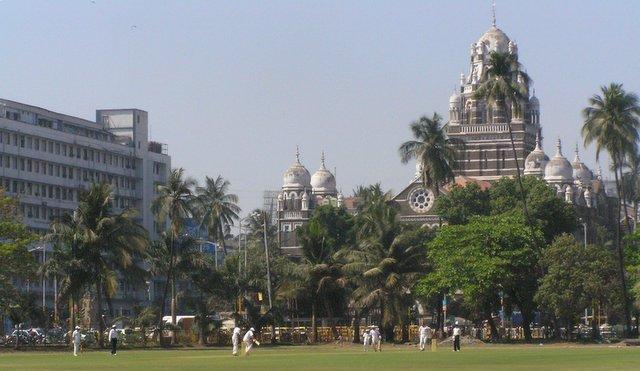 A cricket match in central Mumbai on the Maidan, a large fenced off area with room for several cricket pitches.
Images of India 2005: Goa

Is this the only bus shelter in the world to
have been given World Heritage listing?
Note the ATM with security guard.

Images of India 2005: Varanasi
 The Ganga at Varanasi.
The city, which is built on one bank of the majestic river, is like a supersized rabbit warren, with narrow lanes which disorient the visitor (and perhaps some residents). Not much seems to have changed since 1956 when Satyajit Ray, the great Indian film director, filmed Aparajito (the second of his Apu trilogy) here. Even the monkeys are still a nuisance: Ray recorded the hazards they presented in his memoir My Years With Apu. By a stroke of good fortune I'd bought a copy just before I arrived and so was able to read what he'd written while looking out from the guesthouse balcony at the passing traffic on the river and the ghats.
Images of India 2005: Jodhpur
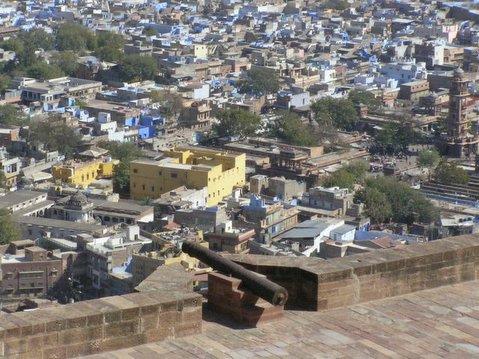 Taken from the ramparts of the Meherangarh Fort, which is a must see (though you need to be prepared for a steep climb to the top). Allow at least half a day to explore what is inside and to look out over the city with its many blue houses and Anglo-Indian style clock tower (on right of photo).
Subscribe to:
Posts (Atom)

