27 January 2006

The his-story man

I have read the Prime Minister's address to the National Press Club . Much media comment has focused on the PM's references to the importance of history and history teaching, eg

Quite apart from a strong focus on Australian values, I believe the time has also come for root and branch renewal of the teaching of Australian history in our schools, both in terms of the numbers learning and the way it is taught. For many years, it’s been the case that fewer than one-in-four senior secondary students in Australia take a history subject. And only a fraction of this study relates to Australian history. Real concerns also surround the teaching of Australian history in lower secondary and primary schools. Too often history has fallen victim in an ever more crowded curriculum to subjects deemed more ‘relevant’ to today. Too often, it is taught without any sense of structured narrative, replaced by a fragmented stew of ‘themes’ and ‘issues’. And too often, history, along with other subjects in the humanities, has succumbed to a postmodern culture of relativism where any objective record of achievement is questioned or repudiated.

Part of preparing young Australians to be informed and active citizens is to teach them the central currents of our nation’s development. The subject matter should include indigenous history as part of the whole national inheritance. It should also cover the great and enduring heritage of Western civilisation, those nations that became the major tributaries of European settlement and in turn a sense of the original ways in which Australians from diverse backgrounds have created our own distinct history. It is impossible, for example, to understand the history of this country without an understanding of the evolution of parliamentary democracy or the ideas that galvanised the Enlightenment.

In the end, young people are at risk of being disinherited from their community if that community lacks the courage and confidence to teach its history. This applies as much to the children of seventh generation Australians or indigenous children as it does to those of recent migrants, young Australian Muslims, or any other category one might want to mention. When it comes to being an Australian there is no hierarchy of descent. Whether our ancestors were here thousands of years ago, whether they came on the First Fleet, in the 19th century, or whether we or our ancestors are amongst the millions of Australians who have come to our shores since the Second World War, we are all equally Australians – one no better than the other.

As a former history teacher I'm pleased to see him calling for an increase in the "numbers learning" (despite the mathematical- utilitarian associations of this phrase). When, however, he links this with a call for radical changes in the way history is taught my feet start to turn cold. He envisages a revised orthodoxy ("structured narrative") replacing the "fragmented stew" so that everything becomes much clearer to the students. His story (of Australia) becomes the new history.

Elsewhere in the address he presents his view of what the John Howard structured narrative might look like:

The great struggle of Australia’s first century of nationhood was to reconcile a market economy with a fair and decent society. At the start of the 21st century, we have found a healthier balance in our political economy between public and private – one in keeping with the times and the contemporary character of the Australian people.

What "great struggle"? This sounds like Marx or Lenin for dummies. How, for example, do the two wars and events within them such as Gallipoli, fit into this scenario?

On the other hand his comment about the "heathier balance" implies that we are well down the road to Utopia (and have switched to driving on the right hand side). At best is a self-serving view of current events, at worst hubristic balderdash.

For an alternative perspective see
this.


Crescent Moon

Today I went to the Crescent Moon exhibition at the AGSA. I was expecting it to be good and it exceeded my expectations. The subtitle Islamic Art and Civilisation in South East Asia is a succinct summary of the content. The exhibition includes many examples of other traditions and cultures which influenced (or were influenced by) Islamic art and culture, such as fabrics and designs from India and China, aboriginal art depicting the Makassan traders who visited the north of Australia for centuries, and European china plates. One of many exhibits which remains in my mind's eye is a ceremonial umbrella made (with a generous supply of gold thread) in Rajasthan and exported to South East Asia.

The exhibition finishes its Adelaide season this weekend but is moving to Canberra from late February to March. For further details see here. If you can't get there the sumptuously produced guide is worth a look (or borrowing, or buying if you can afford $80).


25 January 2006

Radio National again


Update: The ABC has since I posted this contacted me and apologised for the stuff up.


Just as I was composing a post congratulating ABC Radio National on its new program schedule I received an email from the producers of Bush Telegraph telling me that my guestbook post commenting on outback fuel prices had been approved.

This is what I submitted on 5 October last year:

Your report today on fuel prices in Central Australia may have been compiled when prices were at their highest. I drove from Darwin to Adelaide in early September on the last leg of an 8,500 km outback trip and was pleasantly surprised how low prices were compared to the cities now and compared to a previous trip in 1998. In September the difference between city and outback prices was rarely more than 20c a litre: about the same as it was seven years ago. Even where prices are higher they are usually justified by remoteness. Even if I don't need fuel I usually buy something from each roadhouse where I stop as they provide an important service to outback travellers.

Is this too controversial for the ABC to deal with promptly? At least they haven't edited/ censored it.


23 January 2006

ABC Radio National


Today the
Australian reports that the presenter of ABC Radio National Breakfast Program has been counselled for inappropriate comments. What he did was to
ask David Hicks's US military lawyer a forthright question "
if David Hicks is released, will it in fact be a very dramatic illustration that the only reason he's been in Guantanamo Bay over these past four years is because of the bloody-mindedness of the Australian Government?"

A forthright question, which should perhaps have been directed at the government but one which needs to be asked.


20 January 2006

Earle's caught?

Today, despite all the competing demands for space in its sporting pages, the Advertiser gives a full bodied report of SA's defeat of Tasmania at cricket. The reporter seems to be parodying the old cricket writers who got paid by quantity (number of words) not quality, as in "the shimmering haze of a crazed Mediterranean heat drained SA's attacking energy in the first session" and [after a key wicket fell] "the repressive mood engulfing the Redbacks, desperate for maximum points, promptly lifted."

Need more? We are told that one of the Tasmanian players
"executed a rebellious ton that included 15 boundaries and several mini-partnerships with the tail."

I checked to see whether Tasmanian readers were fed the same rich soup. Mr Murdoch's print media reach means that his Hobart outlet the
Mercury can economise by taking the reports from the Advertiser's man on the spot. Perhaps the Mercury has better sub editors or perhaps Tasmanians are less tolerant of verbosity, because the Mercury's report, also attributed to Richard Earle is much less florid. The innings of the Tasmanian who the Advertiser said "executed a rebellious ton" is described by the Mercury as "a bold if fruitless 130".

Which came first: the Advertiser or the Mercury report, and who really wrote each? Is the real Richard Earle willing to stand up?

Rumours of Bill Lawry's replacement are exaggerated...

Just as I was thinking that Bill Lawry might have been eased out of the Channel 9 cricket commentary team he bounced back today with a description of the new gee-whiz sightscreen at the Docklands Sauna/ Stadium (sometimes ka Telstra Dome). He gave a boffinesque explanation of its technical features which made me sit up and listen and, for a while, ponder whether it was really him, or a soundalike, speaking. Fortunately the voice quickly followed up with an "it's all happening" which allayed my fleeting doubts. No one says it like Bill does (or as often as he does).

Putting which foot forward?

I haven't seen this mentioned in the conventional media though it's had a good run online. On the one hand it's reasuring to know that the US Vice President (one heartbeat or should it be one false step away from the Presidency?) is as fallible as many of us; on the other we may well wonder whether this man and his entourage of minders can't do better than this. For a more acerbic comment see
Wonkette

19 January 2006

Snakes on the grass


There wasn't much venom in the pitch at Lahore where India and Pakistan have just played a high scoring draw which will keep the statisticians busy for many a day.

Herpetology and cricket aren't often linked but occasionally the two come together. In 2000 play in the Tamil Nadu - Punjab match at the M A Chidambaram Stadium in Chennai/ Madras (where tests are played) was interrupted by a snake in the outfield. The incident was mentioned in
Wisden 2001 at p1395 and by The Hindu which reported, in a manner reflecting the Indian veneration of snakes, that the reptile "had to be guided out of the ground".

More recently in rural Victoria, as the Herald Sun reports "a deadly brown snake turned out to a be a lucky charm for a teenage cricket star". The young man in question took a hat trick two days after being bitten by the snake. The report doesn't state what happened to the snake: presumably it wasn't "guided out of the ground".


17 January 2006

Stone throwing from within the glasshouse?

The Strewth column in today's Australian has an item "The untold story" which has a dig at The Age for allegedly not printing stories filed after 1pm. This is a bit rich given the Oz's propensity, at least in the edition printed and delivered in Adelaide, to overlook news breaking after lunch. The sporting coverage is especially deficient. Today's Oz has scores of yesterday's play in only two of the three first class cricket matches being played around the country and those only go up to lunch time (ie about 1pm). Things don't seem to have changed much since the Oz began 40 +years ago.


14 January 2006

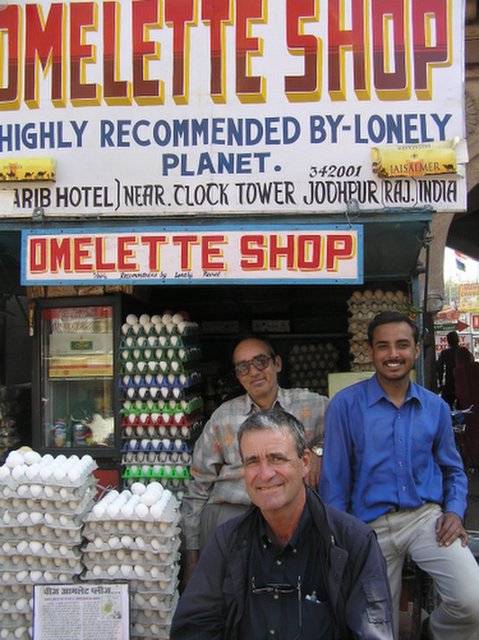
Highly recommended by...


I''ve borrowed the latest edition of the LP guide to Rajasthan, Agra and Delhi from the library to check out a few points about my trip last year.

The guide recommends this establishment. As the photo suggests so do I. The product range may be small but the business name says all that needs to be said.

It is an islet of order, great value and friendly service in a sea of noise and movement which verges on chaos.

Posted by Picasa

11 January 2006

Ascending Mt Lofty

As the weather today wasn't too hot ( 27.6 deg max in the city) I decided to walk from Waterfall Gully to Mt Lofty on the main (most direct) walking track, which has recently been reopened after repairs to damage caused by the November floods. During the closure walkers were diverted to other longer and IMO less attractive tracks elsewhere in Cleland Conservation Park.

To give them their due the National Parks authorities have moved relatively quickly and put in a replacement at the top of First Falls. The force of the torrent must have been considerable: for as long as I can remember a tree trunk segment with a diameter of at least 60cm had been wedged under the bridge.


The impact of the floods is still clearly visible. The torrent has cut a swathe through First Creek above the First Falls (the ones visible from the car park) so that it now looks as if it is possible to walk much of the way along the creek line without being obstructed by blackberries and other vegetation. It's almost as clear as I recall it after the Ash Wednesday fires 23 years ago.

Where the official walking track runs above the creek line, which is most of the way, it has escaped major damage. Only in one or two places, such as Wilson's Bog, has it been badly eroded but nowhere is it impassable to walkers who take reasonable care. The disabled access, which previously extended to the Second Falls, now only goes just past the top of the First Falls, so some further work will need to be done to restore the track to its previous condition. As a regular user I'd be happy to volunteer to help. What I wouldn't want to see is another long closure, such as happened a year or so ago when part of the track was closed for months to repair a small landslip.

The damage along Waterfall Gully Road is being repaired without closing the road (if there was the slightest hint that this might happen there would be a huge outcry from residents). Transport SA not the Burnside Council is doing this work.


As for the walk itself it was extremely pleasant (as it usually is). The steep climb in the upper part of the track made me sweat but as I reached the open ground on Davenport Ridge a cooler breeze kicked in. Near Wilson's Bog I observed a couple of firetails, a bird which I don't recall seeing in Cleland before, which is not to say that they are unknown there.

Time for the walk: just over 59 minutes (I was aiming to do it in less than an hour). As I'd not done it for a while I was quite pleased with this. I returned on the 823 bus which was well patronised, though everybody had a seat even on the connecting 165.


10 January 2006

Groundbreaking research or just stirring the pot?


Today the Australian's gossip column Strewth reports that some enterprising researchers at the Macfarlane Burnet Institute have used their tea breaks (and other probably other time) to research the phenomenon of disappearing teaspoons. At first I thought this was a hoax, even though 1 April is some time away, but the BMJ website lists it.


Summertime

Here in Adelaide at this time of year we expect it to be hot, and it has been. What do I mean by "hot"? Start with 30 degrees C + and keep it at that level for a few days when old houses like mine absorb so much heat that it's cooler outside than in, except perhaps for an hour or two before dawn. Up north, eg Coober Pedy, Alice Springs, Mt Isa, the temperature most days lately has risen above 40 deg. I've heard some locals from those parts say that they can cope because while it may be hotter the heat is drier (even when the monsoon storms and humidity move down from the north). Hmm.

This makes it sound unpleasant but humankind can bear a fair burden of climatic reality, ie is able to adjust. This doesn't mean business or exercise as usual but a sensible adaptation to the climate.

For my part in the hot weather I make the occasional daytime foray outdoors, usually to head to somewhere such as a cinema or library where I know it will be cool. When I emerge into the real Adelaide world hotbox I find that I can begin to appreciate the benefits of the climate, such as being bathed in warm air, and not having to wear layers of clothing. Unless a hairdryer wind is not blowing there is occasionally a brief cooling zephyr which temporarily mitigates the worst of the heat.


09 January 2006

Language or dialect?

Another report from today's Australian tells us that teenage girls are the most powerful influence on the evolution of the English language around the world. "Language"? Why not "languages" or "dialects"? If not does this mean that I and many of my acqaintances are illiterate?

One ex-politician invokes the memory of another

In today's Australian Neil Brown, described as "a former federal minister and deputy leader of the Liberal Party" (do you remember when that was?) invokes some of Winston Churchill's recently published WW2 comments in favour of executing Hitler and his close associates summarily to support his view that more ruthless measures are needed to combat terrorism.

Mr Brown says (striving unsuccessfully to give a Churchillian ring to his words) " we will get nowhere if we are anything short of ruthless and if we continue to handicap ourselves, as we are now, by self-imposed moral and legal principles that are outdated, counter-productive, highly theoretical and guaranteed to do nothing but give the enemy an advantage that could ultimately lead to our defeat."

This is all very well, but note (1) the WW2 German leaders who were captured were put on trial (flawed though the processes were), (2) Saddam Hussein is currently on trial (no sub judice in Iraq?) and (3) Mr B is fuzzy about where all this might end (or if it will).


A commonsense view of David Irving

The BBC reports that Deborah Lipstadt, one of David Irving's major adversaries and one whom he has pursued (unsuccessfully) through the courts, thinks that he should be let go. Professor Lipstadt is quoted as saying "I am uncomfortable with imprisoning people for speech. Let him go and let him fade from everyone's radar screens." IMO an eminently commonsensical view.


US not in for long haul in Iraq?

Further to my post yesterday about Custer Battles the Washington Post recently reported that the US does see an end in sight for rebuilding Iraq. As usual John Quiggin has some apposite comments, as do many other bloggers - click on some of JQ's links or try a Google search for Ellen Knickmeyer to find out more.


08 January 2006

Custer Battles in Iraq: is the last stand nigh?

See this from the current London Review of Books. Decide for yourself what is hearsay and what is heresy.

One of the US firms mentioned in the article is Custer Battles whose website describes Iraq as
"a nation and marketplace wrought with challenges, obstacles, and malevolent actors. " Don't despair, because CB assures us " Iraq offers contractors, traders, entrepreneurs as well as multi-national enterprises an unprecedented market opportunity. The ability to identify, quantify, and mitigate this myriad of risks allows successful organizations to transform risk into opportunity. " Read on for more in this vein.


A word for our times?


The Age reports that a panel of linguists in the USA has voted"truthiness" as the best new word for 2005. It is defined as "
the quality of stating concepts one wishes or believes to be true, rather than the facts".

Words such as "doublespeak" at least assume that the user is conscious of the deception inherent in what they are saying. "Truthiness" gives liars, dissemblers and prevaricators a free hand to say what they like as long as they wish (not necessarily believe) it to be true. Will the "truthiness" defence come to be accepted in legal proceedings?

For other examples of trends which need watching see here .

Let's not forget that this year is the 60th anniversary of the publication of Geroge Orwell's Politics and the English Language an incisive essay which still scrubs up pretty well.


03 January 2006

A cricketer of his time

Gideon Haigh is an erudite and elegant writer on cricket and other topics. Although he is generally thought of as an Australian, he reminds us in the introduction to A Fair Field and No Favour, his recently published collection of his writings on the 2005 Ashes tour, that he is English by birth and an English cricket supporter.

Cricinfo has just published a piece by him on Bert Ironmonger , the pre -Second World War slow left arm bowler.
The title "Tough in life and in cricket" sums it up well:

His was the Australia of rural hardship: Ironmonger was the youngest of ten children to a farming family who had to abandon working an uneconomic block north-west of Ipswich, whereupon at twenty-five he became a labourer on the railways. His was also the Australia of long-term labour: after arriving in Melbourne in December 1913, and working as a barman and tobacconist, he took a job as a gardener with the St Kilda City Council, tending parklands with a handmower until the age of 70, even though his wages were suspended when he was away from work playing cricket.

Ironmonger is the member of a genus of Australians almost vanished from today's land of plenty, a man of what used to be called steady habits,: he was frugal, conservative, neither smoked nor drank, and lived with his wife and children in the same unprepossessing house, with flower beds and vegetable patch, for forty years; they did not have a telephone until 1939, and never owned a car.