07 December 2006

Who knows what's happening in Fiji?

Slightly different takes on the same events can be found at the BBC, ABC and The Age websites. The 77 year old man appointed by Commodore Bainimarama to be PM has admitted the coup is illegal, though he and more particularly the Commodore really seem to be saying that parliamentary democracy is not the best form of government for Fiji.


The Age
and the Acid Test blog have some interesting observations.

Mr Downer our Foreign Minister doesn't seem to be able to shed much light on the situation if this recent ABC report is accurate.

Slight movement on the Hicks front?

The Age yesterday reported that David Hicks's Australian lawyers have been granted an urgent hearing in the Federal Court to hear a claim that the Australian government has failed to provide adequate assistance to an Australian abroad. The matter will be heard on 15 December. The story is updated today: see here.

News.com.au recently reported that Coalition MPs have raised the matter with the PM in a joint parties meeting.

Tim Dunlop at Blogocracy has also discussed the situation, reiterating with his characteristic succinctness that the central issue is the rule of law:

Any reasonable person concerned about the war on terror would understand that a commitment to the rule of law is basic to our understanding of ourselves as a democratic nation in that fight. And yet, the Howard Government has let Mr Hicks languish in the prison at Guantanamo Bay rather than insist that the Bush Administration release him from this legal limbo.

The comments (52 as I post this) are worth reading, not least for the misapprehensions which seem to persist among some members of the public, eg that Hicks fought in Iraq. There are still those who support the "keep him in Guantanamo and throw away the key" view.

It's ironic that these views are underpinning the continuing casuistry of Attorney-General Ruddock, who is supposed to support the rule of law here. He is taking refuge in the position that it's US, not Australian, law which is applicable, and that it's the continued quibbling by the detainees's lawyers which is delaying justice. I don't recall hearing him say anything like this about other matters where cases take a long time to go through the full range of appeals to higher courts.


04 December 2006

New Labor leader (and deputy)


As expected, and as I and almost everyone else with the slightest interest in Australian politics foreshadowed yesterday, Kevin Rudd was today elected leader of the ALP with Julia Gillard as his deputy.

He's already said that his front bench, the composition of which he'll announce later this week, will have some new blood.

It will take a few days to separate the grain of leadership substance from the chaff of media hype ("dream team" etc). Mr Howard has already gone on the attack, beating the drums of union control of the ALP and Mr R's inexperience. No doubt we'll be hearing more of this litany.


03 December 2006

Labor leadership to be contested


Tomorrow is the day which will (unless something very bizarre happens) decide the short- and perhaps even the long-term future of the ALP. The safe pair of hands (which haven't actually held on to every chance that's come their way recently) versus the new broom.

The winner? I'm not an ALP member but like to see a strong opposition to keep the government on its toes.


Kim Beazley, decent man as he undoubtedly is, cannot articulate simply and clearly (the clearly is of paramount importance here) wht the ALP stands for or even how it might change our society for the better. surely he had advisers who can help him remedy ths deficiency?

30 November 2006

Labor's lest than perfectest day


Matt Price's column in today's Australian is a very erudite and witty, albeit all too true, take on the ALP's current difficulties:

The themes of Much Ado About Nothing are disguise, deceit and infidelity as two long-time adversaries, Bennedick and Beatrice, wind up in love. Which would pretty much sum up any Dream-Team ascension - Rudd and Julia Gillard have spent most of their parliamentary careers eyeing each other suspiciously across Labor's poisonous divide.

Thoughts of which prompt a return to Shakespeare:

Men were deceivers ever,
One foot in sea and one on shore,
To one thing constant never.

Four hundred years old, still the perfectest description of caucus you're likely to hear.


27 November 2006

The incredible shrinking GG


The Weekend Australian
carried a substantial profile of the Governor-General by Kate Legge, an edited version of which, minus photos, has been published online at news.com.au.

A sample (which shows that he and the Prime Minister appear to think alike on many things):

Invisibility doesn't suit Major-General Jeffery, who likes a media plan for every event despite being inherently risk averse. He is greener than the Prime Minister on climate change, which he says has been confirmed by science as "pretty definite" for the past five years, but for all his alarm he will not attack the Coalition's refusal to sign the Kyoto Protocol.

"I believe we can't take the risk of ignoring carbon emissions ... if we get that wrong we're in deep trouble," he said, advocating alternative energy sources such as thorium, wind, solar power and uranium.

"I think uranium will come ... Australia does have the most stable geography and it would be silly to rule uranium out because we're a bit frightened of another Chernobyl, but nuclear power plants would need to be built to the highest standard."


23 November 2006

Nothing to offer but blood, spice and broccoli...


During President Bush's recent visit to Indonesia a gentleman coyly described by CBS News as a "Voodoo Practitioner" prepared and drank a potion, thereby casting a jinx over the President.

The recipe appears to have been taken from the cookbook of the witches in Macbeth, with some input from Jamie Oliver:

Ki Gendeng Pamungkas slit the throat of a goat, a small snake and stabbed a black crow in the chest, stirred their blood with spice and broccoli before drank the "potion" and smeared some on his face.

The broccoli has your fingerprints on it, Jamie, but I'd like to know for how long it was stirred in the blood.

While sceptics might dismiss all the jinx talk as superstition there have been, according to US blogger
Boozhy , some interesting developments since the ceremony:

It seems Bush has fallen out of the roll of God's Favorite, as the curse seems to have worked due to the fact that chaos has certainly ensued following Mr. Pamungka's curse. First, daughter Barbara had her purse burgled right out from under her cute perky little nose, while the Secret Service looked on. Second, two motorcycles in Bush's motorcade crashed yesterday, leaving three officers injured and one in serious condition and finally, top White House official and acting Director of the White House Travel office, Greg Pitts, was beaten and burgled yesterday outside of a Honolulu night club.


22 November 2006

Unsatisfactory garbage collection

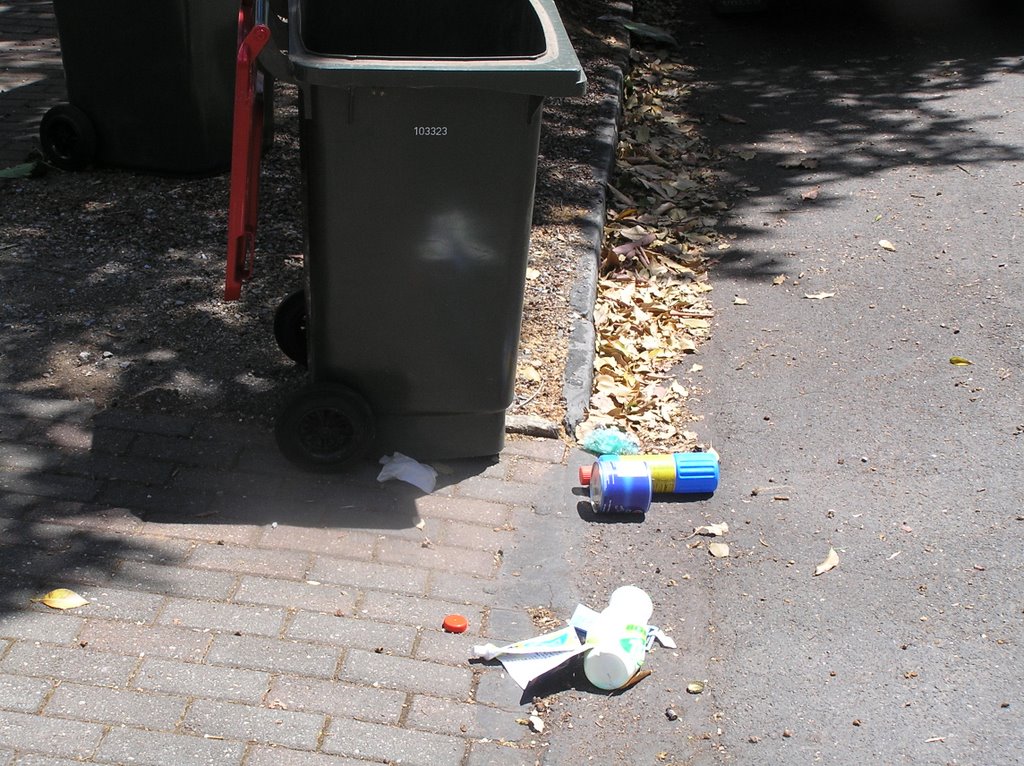
When I went to retrieve my rubbish bins this morning I found that one of them, shown here, had not been properly emptied, and the other (not in picture) had been overturned. This isn't the first time I've had poor service from the collectors.

The rubbish collection is contracted out to East Waste. I complied with their collection policies but this did not prevent them from doing a shoddy job.

I went to the council offices today and notified them of my concerns, and will await a response from either them or East Waste.

I cleaned up the mess shown in the photo myself.


Never too late to get on the rails

An interesting story from the UK Daily Mail about Giles Wilson, son of former British PM Harold Wilson who switched career tracks late in life from teaching to train driving.

He recently gave up his lifelong career as a teacher to fulfil his boyhood ambition of becoming a train driver, and has started by driving trains from Waterloo in central London to Guildford and Dorking in Surrey.

Mr Wilson is so passionate about trains that he has bought and restored at least two disused branch line stations in the West country, including his current weekend home near Exeter.

During the week he lives alone in a modest flat in Belsize Park, north London, where he is visited by his mother Mary, 88, and brother Robin, 62.

A family friend said: 'Everyone was a bit surprised that he should take up driving trains as a career.

'It was well known he was a rail enthusiast, but not that he was so serious he planned to be a driver full time.

'It is one thing loving the world of railways but quite another to actually work for a rail company. But he has made that decision and seems to be very happy with it.

'Who knows what his father would think. I'm sure he would not have expected him to end up a train driver.'

Mr Wilson refused to discuss his decision to change careers, insisting that he has always avoided publicity.


20 November 2006

The Deep End to end


ABC Radio National plans to drop the weekday editions of its arts program The Deep End . I'm very sorry to learn this as over the last year or so I've moved from being an occasional to a regular listener.

Each day the program presents several arts-related items. For example, today it discussed

# an award for new video and media art,

# an open air sculpture exhibition in a small SA coastal town,

# cult film and television classics (the first of a new, and presumably brief, series) and,

# a hand-wound free play radio (part of the regular Monday to Friday "Deep End Five" countdown of the "best of" something, this week's topic being "objects and systems that promote sustainable lifestyles").

The Deep End is well produced and Amanda Smith, the presenter, consistently engages listeners with her
friendly manner and detailed knowledge of the arts.

The ABC has issued an
an explanation where the RN station/ network manager is reported as saying

I’m not thrilled about it, and a little bit of it is to do with resources, but most of it is to do with, what will serve the arts best...
Arts is a difficult area to cover. It’s difficult on radio because so much of what you’re talking about is either visual or local, and for a national radio network it’s a tricky area to bring to life. And it also has within it stuff like arts funding policy, which is incredibly important, but again can be difficult radio.

We were beginning to feel that, on a daily basis, in-depth, analytic conversations about where the arts are heading in Australia and around the world (was too hard) without a really high level of resourcing and specialist staff that we probably had in the 80s and 90s, but are unable to sustain in 2006.

Radio National is a very expensive network to maintain, because of the level of depth we want to bring to everything we touch, and over time priorities about what we want to bring that depth to change.

This is full of weasel words. Can anyone translate "The level of depth we want to bring to everything we touch"(or the entire passage) into plain English?

I don't have enough inside knowledge to crack her code, but wonder what what is really happening.

19 November 2006

GG blues


Glenn Milne at news.com.au reports that the Governor General and his wife are " victims of a whispering campaign in Canberra, driven by claims Government House has become pompous and self-important".


If anyone has become pompous and self-important it is the
Prime Minister, who has marginalised the GG by taking a leading role at many major events, leaving Major General Jeffery to officiate at the less important ones. Earlier this year I calculated (by looking at their respective websites) that the score for appearances at the Commonwealth Games was PM 5 - GG 2.


Mr Howard has effectively become President Howard of a de facto Australian republic. This is not necessarily a bad thing, though it leaves the GG in limbo, a comfortable limbo to be sure, but one which has no doubt increased the Vice-Regal couple's frustrations. I expect that the PM/ President will continue to live his double life, because the obstacles in the way of a formal change, eg referendum, are formidable and I believe many Australians will continue to feel relaxed and comfortable about accepting his spin on matters, including much more important ones.


16 November 2006

Government keeps SA public in dark

Two instances of government fudging in SA. The first, where the state government, more specifically Transport Minister Patrick Conlon, has refused to disclose the amounts paid for land for the planned northern suburbs expressway.

LAND acquisition cost estimates for the new $550 million Northern Expressway will not be revealed, so the Government does not "pay more than it should by being indiscreet".Transport Minister Patrick Conlon said the land acquisition was a major component of the project. "One of the things we are not going to do is separate out the components of funding," he said."If we say we have X dollars for acquisition then that's what people will be asking us for."

"We are not going to set the Government up as a patsy in this regard. Everyone can be assured the project will go to the Public Works Committee and every detail will be known."

He said feedback on the expressway and its new route had been positive. "Land acquisition does not need to take place for another 18 months," he said.

"We are treating this with urgency and sensitivity. There are always going to be difficulties and controversies."

Construction is expected to start in 2008 and completed in 2011, with parts of 79 properties likely to be acquired.

Mr Conlon said some landowners would be less happy than others, but the bottom line was if the Government was not prepared to do these things, the state would not have the infrastructure it needed.

The state's largest road project for more than 40 years, the expressway runs past Penfield and Gawler's western edge.

The four-lane expressway is designed to boost freight links from the Sturt Highway to Port Adelaide.


At the local government level there's been a lot of buckpassing aboutdisclosure (or non-disclosure) of remuneration of council staff.

LOCAL councils are paying nearly 100 of their executives more than $100,000 a year and many receive performance bonuses.

The Adelaide City Council has 25 staff on more than $100,000 and 12 are paid bonuses.

The Port Adelaide-Enfield Council has 22 officers earning above $100,000 and also pays performance bonuses of 1 per cent a year.

But the full extent of the bonus payments and salaries paid are not available because some councils are refusing to release the information.

Independent MP Bob Such wrote to all 18 councils in September, asking a series of questions about payments to executives, use of council cars and whether staff were given rostered days off or time off in lieu of overtime.

Only 10 councils replied, while Onkaparinga, Charles Sturt and Holdfast Bay said the Local Government Association would respond on their behalf.

Replies were not received from Prospect, Marion, Adelaide Hills, Mitcham, and Norwood, Payneham & St Peters.

Of the 10 who did, four councils said they paid employee bonuses - Salisbury, Adelaide, Campbelltown and Port Adelaide-Enfield.

Salisbury pays the city manager $15,000 extra a year "subject to performance assessment", Adelaide pays 12 staff bonuses which are "performance based", Campbelltown pays its managers bonuses based on performance, while Port Adelaide-Enfield executives are paid a 1 per cent bonus based on occupational health and safety targets.

Only Burnside, Campbelltown and Walkerville said they did not provide cars or reimburse mayors for using a private car on mayoral duties. Only Walkerville said it paid extra superannuation as part of an executive package.

"Councils are not there to make a profit," Dr Such said. "They are there to serve the community like the public service."

Local Government Association executive director Wendy Campagna wrote to Dr Such, saying four of 68 councils in the state use bonus payments.

"They are common-place in private industry and at a time when there is a skills shortage in management expertise," she said.


Dr Such, as often, has a good point here: councils are not there to make a profit. Ms Campagna's explanation is disingenuous: the website of Local Government Association, her employer, states clearly: "Councils are part of our system of government".


15 November 2006

Bono in town? What about Rupert?

Readers of today's Advertiser front page were teased about the prospect of Bono being in Adelaide a day or two before tomorrow's U2 concert. Nowhere in the paper was there a mention of Mr Murdoch's visit for the News Corporation local shareholders meeting.

Were the editor and his staff apprehensive about stepping on their boss's toes on the one day of the year when (it could reasonably be assumed) he'll read what they print over breakfast.

Well, they made up for it later by putting online a story about Mr M complaining (IMO justifiably) about poor broadband speeds here, as well as video and podcast interviews with the great man.

They also did not overlook an important local event : the testimonial dinner tonight for Darren "Boof" Lehmann.

UPDATE 16 NOVEMBER: Today's print 'Tiser certainly makes up for yesterday's omissions, with a front page story "Murdoch urges water rights buyout" as well as a page five stories repeating his plea for improved internet access (see above) and a briefer tribute to his philanthropy "Avenue of Generosity" about his significant contribution to the Adelaide Botanic gardens redevelopment fund. If you don't know how much he gave, read the story.


Last rites for states' rights?


The High Court's decision in the Work Choices case
New South Wales v Commonwealth of Australia; Western Australia v Commonwealth of Australia has attracted much media comment.

The Australian includes comments from Brad Norington, Chris Merritt, Joseph Kerr, Mike Steketee , Matt Price and P P McGuinness.

The Age's coverage includes contributions from Kenneth Nguyen, George Williams , Michael Gordon and Meaghan Shaw and Michelle Grattan.

Blog postings include those by Tim Dunlop "The states are dead", Ken Parish at Club Troppo "Reports of the death of federalism are much exaggerated" and Andrew Norton"Is higher education next?"

I've not read the full judgment but after looking at extracts and some commentary I add my five cents' worth:

# The decision continues a trend towards centralisation which has been evident for some time, and which has been generally welcomed (or tacitly accepted) by both major parties.

# The Federal Government is unlikely to expand its authority in the short term, but will continue the current trend towards making the states more accountable for their spending.

# Major constitutional changes will be difficult to achieve given the referendum requirements (majority of votes in a majority of states) of the Constitution.

# Premiers Rann and Beattie are unlikely to achieve much from their call for a constitutional convention.

# If the worst case scenario eventuates Mr Rann will make a good Mayor of South Australia.


12 November 2006

The Road to Guantanamo


Yesterday I saw The Road to Guantanamo, a dramatised documentary which follows some English-domiciled Muslims who in 2001 travelled to Pakistan, then to Afghanistan, where they were captured, incarcerated at Guantanamo Bay and eventually released after their interrogators were unable to elicit enough information to bring them before what passes for a justice system in the war against terror.

The movie has an authentic ring to it - the depiction of the Guantanamo Bay camps looks particularly convincing and not all the guards are absolute b*stards all the time - and will inevitably remind Australian viewers of David Hicks.

The Australian government hasn't had much to say about the movie yet, though it has refused a visa to one of the characters depicted therein.

I recommend the movie highly, and not only to those for share my views.


11 November 2006

Unfamiliar sounds

As I write I can hear thunder and rain outside. Why is this unusual? Well, in these parts we've not had much rain lately.

I haven't taken any photos but someone not a million miles from here has .

10 November 2006

Government re-thinking or re-fudging David Hicks?


Tim Dunlop at Blogocracy has an excellent post "Mr Howard's Bushy blind-spot" in which he summarises some recent developments in the David Hicks case and states:

Any reasonable person concerned about the war on terror would understand that a commitment to the rule of law is basic to our understanding of ourselves as a democratic nation in that fight. And yet, the Howard Government has let Mr Hicks languish in the prison at Guantanamo Bay rather than insist that the Bush Administration release him from this legal limbo.

There seem to be some indications that the government is shifting its ground a little from, for example, the view expressed by Foreign Minister Downer in July. The Senate has, at Barnaby Joyce 's urging recently passed a resolution urging that David be brought to trial quickly, and there are reports that Attorney-General Ruddock has agreed to meet Terry Hicks, , David's father. Even so I'm not expecting a quick resolution of the matter.

Iraq veteran's bum steer


I can't resist mentioning this story about a UK bonfire night prank which went horribly wrong. The victim- perpetrator was trying to reenact a stunt from the movie Jackass, but the outcome showed that life does not always imitate art...

PS The Age report also includes what is claimed to be a photo of the take off.


Australians " totally uncivilised"

Also posted at Nudges and Deflections

The Australian team, notably Messrs Ponting and Martyn, have been described by Sharad Powar, the head of the BCCI (Board of Control for Cricket in India) as "totally uncivilised" for their behaviour at the Champions trophy presentation.

I know from personal experience that Indian people set great store by ceremonial protocol: at most functions there is a hierarchy of guests, with the chief guest, in this instance Mr Powar, being the most important. Ceremonies with each guest, beginning with the least important, being acknowledged, and usually invited to speak. Nothing should disturb this. In my only appearance at such a ceremony (not, alas, related to any performance on a cricket field) I was speaking when the power failed. The show nevertheless went on: fortunately I was speaking off the cuff and was able to finish quickly and allow the next speaker their turn (half way through which the lights came back on).

Acording to Cricinfo Cricket Australia is trying to hose the matter down, though to my mind CEO James Sutherland's comments seem a bit bland for an Indian audience, however well they may go down in Australia:

James Sutherland, Cricket Australia CEO had said yesterday that the relations between both boards were absolutely fine. "It's unfortunate that there has been an interpretation of disrespect from that. I know that no disrespect was intended by the Australian players; I have spoken to Ricky about it. Perhaps sometimes these things can happen between different cultures."

For a sample of Indian opinion see these pieces from Hindustan Times , Times of India and The Hindu. Here's an extract from the latter:

We respect the way Australia runs its cricket and we respect the way Australia plays its cricket, which is probably why half the Australian team strides around on Indian television hawking stuff. (We certainly don't respect our board president getting pushed around).

But in Australia, respect for Indian cricket is grudging, if at all. The talking-down, slightly supercilious tone that some use (which we got for years from the English and still do in some places) bothers me.

Culture shock

It bothers me also that this is what you often read about India in Australian sports pages. Chaotic. Noisy. Dirty. Cracked pavements. Delhi-belly. Yawn. It's true, but it's also all so 1980s about a country that's changing every day. It's intriguing, too, that culture shock only occurs going from West to East.

Presumably this shock explains why few write about how well Australia's players are treated in India.

I'm not being precious, I'm just plain bored. And wondering, is there nothing in pulsating, economically powerful, rapidly changing, complex India, which is interesting (and I'm not talking about elephants on the street and the maharajas).

India may not be big news in Australia but it is elsewhere in the world, and by resorting to lazy stereotypes some cricket writers, who are the primary messengers, are not being entirely accurate messengers. Writers in Australia such as Peter Roebuck, Greg Baum and Chloe Saltau, and former cricketers like Ian Chappell, do a fine, thoughtful job, but I find them lonely voices. After all, if anyone wants to know about India, all they have to do is ask: we love talking.
Guilty until proven innocent?


Several serious charges have been laid against the former NSW Aboriginal Affairs Minister, Milton Orkopoulos. Premier Iemma has according to The Australian dismissed him from the ministry and as a state MP.


While I don't in any way play down the gravity of the charges it concerns me that due process, especially that a person is innocent until proven guilty, has not been applied here. The correct thing to do would be to stand down Mr O from the ministry, to withdraw his preselection for the election due early next year and to ask him to resign as an MP pending the outcome of the case.


06 November 2006

1984 - 2050?


Today on the News Ltd website a new blog, Blogocracy began. On the evidence of today's prolific output, and the author, Tim Dunlop 's , other blog , he will look at local and world affairs from a different perspective from most of the other News Ltd columnists/ bloggers. This is most welcome.

Having said this I thought that one of his posts today "I'll stop calling the Howard Government Orwellian" went over the top. Although he refers to the Appendix to 1984 in which Orwell outlines the principles of Newspeak (the artificial language which aims to prevent the expression of ideas at odds with official ideology), he accuses the Howard government, or more accurately Parliamentary Secretary Robb of being Orwellian for seeking a replacement for the term "multicultural".

Mr Robb may be able to come up with another term to replace "multicultural" ("diversity", "harmony"?) but I'd be surprised if it happened suddenly, as IMO the word has taken root in Australian public (if not everyday) parlance. All governments, and political parties (not to mention many other bodies), seek to manipulate language for their own ends, yet for Dunlop to imply that the Howard government somehow stands alone on its own axis of linguistic evil is to overstate his case. In fact in his elaboration of his headline he waters down his argument considerably, but it's the echo of the headline which remains in the mind. In the 1984 Appendix Orwell said that didn't expect Newspeak to be completely established in his dystopian society until about 2050. Perhaps the novel should now be renamed (or subtitled) "2050"?


05 November 2006

Culture of complaint against public broadcasters continues


UPDATE 6 November: Matt Price's article referred to below is now online here.

ORIGINAL POST (unchanged except for one typo corrected)
"Aunty and co face Neo-Connie's wrath".This is the title of Matt Price's column in today's Weekend Australian. To read it (and like most of Matt's stuff it's worth reading) you'll need to go to page 20 as, unlike most if not all his other pieces, this isn't online. I won't speculate why.

"Aunty" is of course the ABC, about whose current travails Matt has written previously, such as here.. "Neo-Connie" is NSW Senator Concetta Fierravanti-Wells , aka, as he puts it "Connie to her pals, neo-Connie to detractors", who "chooses to patrol the public broadcasters for signs of far-Left bias. Which, in neo-Connie's eyes, are everywhere".

He also has a critical thing or two to say about Victorian Senator Michael Ronaldson aka "neo_Ronnie", who "is less dedicated culture warrior than knockabout bully to whom broadcaster bashing is more sport than religion" .

The two Senators used the recent Senate estimates hearing to quiz, harangue, berate - call it what you will - the managing directors of the ABC and SBS about alleged left wing bias. Matt gives some examples of their lines of questioning and comments about the increasingly abrasive tone they used. The committee chairman (also a Liberal) "was plainly embarrassed and to his great credit intervened to chide his ultra-aggressive colleagues".

He continues

As taxpayer-funded outfits, ABC and SBS should be answerable to senators scrutinising government. If people such as neo-Connie feel compelled to complain about nudity on SBS, it's a small price to pay for public funding.

But the bullying is out of control. John Howard has stacked the board that chose [Mark] Scott as the man to lead the ABC into the complex, ever-changing digital era. On Monday's performance [at the Senate estimates hearing], he'll do a good job. The appointment of an editorial director to guard against partiality is contentious and bureaucratic and won't stem criticism of the ABC. But you'd think government senators would at least give Scott a settling-in period. Instead, neo-Ronnie and Connie roundly mocked and scorned the ABC chief, who stoutly defended the corporation against their generally absurd, overblown attacks.

It's easy for a senator with a tramscript and a chauffeur to sit on their air conditioned ar*e and blithely lambast a war corespondent for using the term militant instead of terrorist during a live interview, often conducted in a battle zone. Scott ignored the snide comments and insults, lauding the professional judgment of his reporters and explaining how 65 radio stations running live around the clock will produce an array of content, not all of it necessarily adhering to a bureaucratic formula.

Wait for the futile nitpicking to increase as Labor and the minor parties mirror the Liberals' tactic of bombarding the ABC, in particular, with complaints...No good can come of this, and the obsessive, unreasonable antics of neo-Con and neo-Ron will eventually backfire on unreasonable critics of ABC and SBS.

Unless I'm wrong, audiences and voters much prefer the flawed public broadcasters to pissant, pedantic politicians. And by the time Labor and those far left-wing leftists eventually win office, nuisances such as neo-Connie and neo-Ronnie will have written the rule book for egregious political interference.


02 November 2006

Listening to books on the ABC


Among the rarely acknowledged (by others) pleasures of ABC Radio National are the book readings: First Person (weekdays at 10.45 am as part of The Book Show) and the Book Reading (weekdays at 2pm, repeated at 11 pm). You can also listen to them via the internet.

Not every book chosen is to my taste, but the current ones have grabbed my attention. First Person is featuring Charmian Clift's Mermaid Singing and Peel Me A Lotus, which describe life with her family on a Greek island in the 1950s and 60s. In yesterday's episode she vividly depicted the life of the islanders, notably the backbone of their economic life: the annual sponge fishing expedition which took the men who sailed off in the boats to the limit of their endurance and, in the case of some of the divers, beyond it.

The Book Reading is presenting Strike, described on the program website as "
a previously unpublished novella by the Australian poet, David Campbell (1915-79) who served with distinction during World War Two." It depicts wartime service life at Batchelor airfield in the NT and points north. Adrian Mulraney's reading is first class: like all good readers he varies his tone to distinguish between characters (most of whom are male), while in the more descriptive passages evoking both the routines and boredom of service life and the gut-tightening apprehensions of action.

Campbell is better known as a poet. For more about him and to read some of his poetry, including "Men in Green" which reflects upon another incident in WW2, see here .


I wonder what those, eg Frank Devine, who are continually banging on about its lack of balance etc would make of the ABC doing what it has done to promote Campbell 's literary reputation. After all Campbell was hardly your typical latte leftie: he came from a prominent pastoral family, and for much of his life maintained a close connection with the land.

Well done, whoever at the ABC chooses the books. Enjoy your lattes.


31 October 2006

Blogger troubles

Over the weekend something went awry with my Blogger beta (claimed by many bloggers to be a great improvement upon Blogger ordinary). It's not possible for blogs to revert to the earlier version so, to reduce the risk of being left without any personal online forum, I set up another two blogs Casting a Short Shadow 2 and Nudges and Deflections 2 to mirror or, in the worst case eventuality, to replace the Blogger beta "upgrades".

Well, as you can see from this, a kind of normality has been restored, but I won't delete the no.2 blogs just yet.

For the record here's what I posted on Shortshadow 2:

Monday, October 30, 2006
Blogger beta restored...

Blogger beta has now been restored, so I'll revert to http://shortshadow.blogspot.com/ for postings but keep this for the time being as a backup in case of further interruptions.


Saturday, October 28, 2006
Back up

I've created this blog as backup for my principal one Casting a Short Shadow, which I'd transferred to beta blogger hoping and expecting that it would work better. Alas, a combination of factors, including problems Google are having with beta blogger and my own low level of technological competence, have dashed my hopes, so I'll keep this one going for the time being.

I've done the same with my mostly cricket blog, the overflow version of which is Nudges and Deflections 2

28 October 2006

The Mufti speaks


The comments of Sheik Hilali have been reported not only in the Australian media, eg this "edited transcript" from The Australian but also internationally, eg the BBC, Al Jazeera, CNNand The Guardian.

I find it difficult to get inside his mind, and in particular wonder why he is not fluent in English after 20+ years' residence here.

While the Mufti is reported as apologising for his remarks, he has apparently not retracted them, and has exacerbated matters by claiming, as The Age and the ABC among others have reported, that he will only resign "when the world is clean of the White House first". This will only intensify the anti-Islamic feeling among non-Islamic Australians and perhaps some Islamic ones as well.


26 October 2006

Back on line

I wasn't surprised to learn that my computer hard drive needed to be replaced. I've spent much of the day reinstalling or trying to reinstall programs.

For the last week I've used computers in local libraries to check my email, but didn't have time to do much else.

I hope to resume more regular postings soon.

20 October 2006

Withdrawal symptoms

Last night my computer crashed, so I'm posting this from the local library while I wait to see if the hard drive can be brought back to life. I shall return, but for now I can't say just when.

17 October 2006

Not the Mark Scott who robbed his own bank


The recently appointed ABC managing director, Mark Scott (not to be confused with his NZ namesake who robbed his own bank) has effectively conceded that the mostly right of centre critics of the ABC are correct. He has said in a speech to the Sydney Institute

I suspect the truth is that we are by no means as bad as our critics might suggest and not as blameless as our defenders might wish. My focus, however, is on the future and ensuring our performance is better in the future.

He proposes a number of changes, which are summarised in the ABC media release:

1. ABC Editorial Policies now [ or will from March 2007] require the ABC to be able to demonstrate impartiality at the platform level (i.e. the individual television or radio network, or on ABC Online) for opinion, topical and factual content. This means the ABC must provide its audiences a range of different perspectives on the subject under consideration.


2. A new content category called Opinion is being recognised within ABC content for the first time. This is content presented from a particular point of view about a matter of public contention. This content will be signposted and the requirement for impartiality will mean a range of views must be presented over time.

3. A new position, Director of ABC Editorial Polices will be created to report to the Managing Director in his role as Editor-in-Chief to provide independent assessment of editorial performance.

How effective will all this be? This morning on RN's
Breakfast (one of the programs which Scott praised in his paper), Fran Kelly quizzed him about how far the "Opinion" category might extend. Did it cover reviews of films such as An Inconvenient Truth which dealt with "matters of public contention"? Apparently yes. At the Movies will now, it seems, be "signposted". Is this Scottspeak for saying that there will have to be some kind of right of reply to anything which the DABCEP deems contentious or unbalanced? Sometimes circumstances change rapidly so that yesterday's perceived imbalance becomes today's middle of the road position: for example, Mr Howard and some of his ministers have shifted their ground considerably about climate change in the short time since An Inconvenient Truth was released here.

How too, will the "range of different perspectives" be provided? Point 1 implies that entries in online guest books and forums (which many radio and TV programs now have) will not be sufficient as they are on a different "platform". Will the guest books themselves have to reflect this "impartiality". Already these comments are usually moderated: will the ABC have to implement a quota system to ensure this?

Will the changes also encourage critics to whom Scott refers as "those who sound off against the institution but appear never to be reluctant to sound off before an open microphone and receive an endorsed appearance cheque" ? Will the "rigorous, intense and well-mannered discussion " which he asked for at the begining of his Sydney Institute speech be possible in his new world?

Other bloggers have weighed in to the debate Here , here , and here are some with whom I generally concur.


Wrestling with ideologues #2


The Australian is not letting up on its criticism of the deficiencies which it perceives in our public secondary schools, about which I've posted previously . Last weekend it published an editorial "Little Red Curriculum" which raised the spectre of Maoist ideologues corrupting the minds of our youth.

It has produced a variety of responses including these . A very good one was published today with the headline "Mao and maths don't mix". The writer begins "I'm a teacher, a maths and physics one for that matter and, try as I might, I have been unable to teach Maoism and physics/ maths in harmony with each other". After making some other points, including that he's met "left-wing, fruit-loop teachers" but "they represent a bizarre anomaly and are not in significant numbers", he concludes "There are many serious issues in education that require the attention of serious people. This 'lefty, commie' political diversion is not one of them". Hear, hear.


15 October 2006

Nudges and Deflections


Today I've started a new blog Nudges and Deflections about cricket. I expect that I'll have a lot to say over the coming months; beyond that....well, who knows?


Where is the next drink coming from?

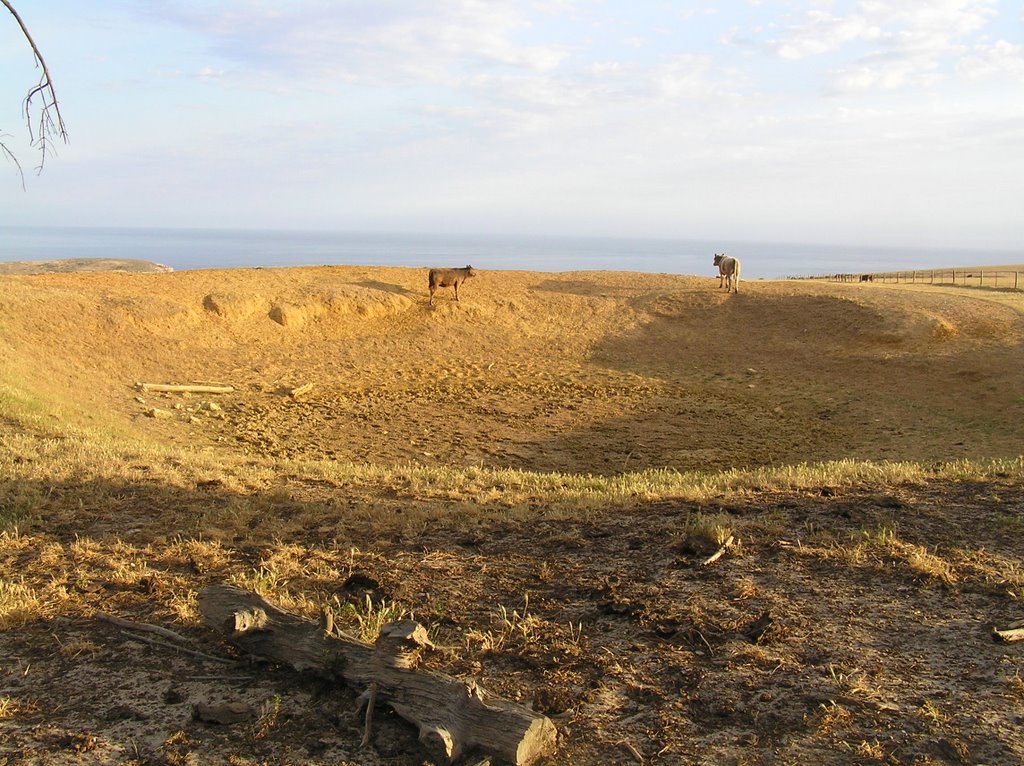
I took this on Friday near Victor Harbor, which is in, by South Australian standards, a high rainfall area. That's the sea in the background. The empty dam shown here would normally at this time of the year have enough water to satisfy the cattle.


Parish pump malfunction


In my letterbox today was the first communication I've received from my two local councillors, who were hoping to be re-elected in the forthcoming elections. They reported that because the only other candidate for the ward had withdrawn her nomination the State Electoral Office has deemed the election to have "failed". This means that the ward will be unrepresented, as their missive states," until a supplementary election is held sometime in 2007".

This is preposterous. Councils or, more specifically, elected councillors may not have much clout (they didn't do anything to modify the planned development next door to me which has now resulted in much of my natural light being blocked off) but some people, like me, believe that citizens should be given some opportunity to influence how they are governed. Even so, I'm not surprised that none of the Council's , State Electoral Office's , Local Government Association's , or the Minister's websites mention it.

This is all relatively small in the scheme of things, but it would be good to see something done, and soon, to remedy this.


12 October 2006

Another literary prize


The 2006
Nobel Prize for literature has been won by Orhan Pamuk . Unlike the Booker, which is awarded to a particular book, the Nobel is awarded to a writer for the body of work which they've produced.

The brief citation on the official website refers to Pamuk as a writer "who in the quest for the melancholic soul of his native city has discovered new symbols for the clash and interlacing of cultures". More detailed "biobibliographical notes" (in English) are posted elsewhere on the Svenska Akademien website.

At the same time as his win is announced comes a report from the BBC that the French lower house has voted in support of a bill making it an offence to deny that Turkey committed genocide against Armenians in 1915. If you know anything at all about Pamuk you'll know, as I've previously posted and
The New York Times states in its report of the Nobel Prize, that Pamuk has been in trouble with the Turkish authorities:

Pamuk, whose novels include ''Snow'' and ''My Name is Red,'' was charged last year for telling a Swiss newspaper in February 2005 that Turkey was unwilling to deal with two of the most painful episodes in recent Turkish history: the massacre of Armenians during World War I, which Turkey insists was not a planned genocide, and recent guerrilla fighting in Turkey's overwhelmingly Kurdish southeast.

''Thirty-thousand Kurds and 1 million Armenians were killed in these lands, and nobody but me dares to talk about it,'' he said in the interview.
The controversy came at a particularly sensitive time for the overwhelmingly Muslim country. Turkey had recently begun membership talks with the European Union, which has harshly criticized the trial, questioning Turkey's commitment to freedom of expression. The charges against Pamuk were dropped in January, ending the high-profile trial that outraged Western observers and cast doubt on Turkey's commitment to free speech.

Apart from watching developments in the next few days and beyond, I'll also be looking to read more of Pamuk's work: earlier this year I read Snow, and I hope to try My Name is Red next.


Bookie Prize


The winner of this year's Man Booker Prize is Kiran Desai for her novel The Inheritance of Loss , which is not yet available from booksellers in Australia. Why not? Many Australians, including me, would be keen to read the winner of such a prestigious award asap; but the only way of acquiring a copy is to source it overseas. No doubt the book will be available here soon, but the delays in doing so make the local book publishing and distribution trades (or their global parents) look inept.


While I'm on the topic, my eyebrows were raised by the official official Man Booker Prize website which features a link to the "Man Booker bookie". I don't particularly mind if people want to bet on the outcome, but what would happen if bookies were allowed to advertise on, say, the websites of sporting bodies?


09 October 2006

Watch out!


The Independent (also available here)has just published a 7,000 word piece by Robert Fisk in which he reviews the history of the Middle East over the past 31 years and his part in reporting it. Did he predict some of the things that have happened? Reviewing his old notebooks, he finds that he did issue some general warnings, but of course he couldn't predict the precise nature of the attacks.

Here's a sample which captures the flavour of his style:

I don't like journalists who, in middle age, start to pontificate morbidly about the wickedness of a world that should be full of love, or who rummage through old notebooks in search of pessimism. So I own up at once. Surely we don't have to be weighed down by the baggage of history, always looking backwards and holding up billboards with the "The End of the World is Nigh" written in black for readers too bored to look at the fine print. Yet when I sit on my seafront balcony today, I am waiting for the next explosion to come.

Beirut is a good place to reflect on the tragedy through which the Middle East is now inexorably moving. After all, the city has suffered so many horrors these past 31 years, it seems haunted by the mass graves that lie across the region, from Afghanistan to Iraq to "Palestine" and to Lebanon itself. And I look across the waters and see a German warship cruising past my home, part of Nato's contribution to stop gun-running into Lebanon under UN Security Council Resolution 1701. And then, I ask myself what the Germans could possibly be doing when no guns have ever been run to the Hizbollah guerrilla army from the sea. The weapons came through Syria, and Syria has a land frontier with the country and is to the north and east of Lebanon, not on the other side of the Mediterranean.

And then when I call on my landlord to discuss this latest, hopeless demonstration of Western power, he turns to me in some anger and says, "Yes, why is the German navy cruising off my home?" And I see his point. For we Westerners are now spreading ourselves across the entire Muslim world. In one form or another, "we" - "us", the West - are now in Khazakstan, Afghanistan, Pakistan, Iraq, Egypt, Algeria, Yemen, Qatar, Bahrain, Kuwait, Saudi Arabia, Oman and Lebanon. We are now trapped across this vast area of suffering, fiercely angry people, militarily far more deeply entrenched and entrapped than the 12th-century crusaders who faced defeat at the battle of Hittin, our massive forces fighting armies of Islamists, suicide bombers, warlords, drug barons, and militias. And losing. The latest UN army in Lebanon, with its French and Italian troops, is moving in ever greater numbers to the south, young men and women who have already been threatened by al-Qa'ida and who will, in three of four months, be hit by al-Qa'ida. Which is one reason why the French have been pallisading themselves into their barracks in southern Lebanon. There is no shortage of suicide bombers here, although it will be the Sunni -- not the Hizbollah-Shiite variety -- which will strike at the UN.

This is Fisk at his best: describing the situation and outlining what will probably happen if things don't change. As ever, he doesn't suggest ways of avoiding this (and he's said elsewhere that it's not a journalist's job to do so), but it would be good to hear what he, with his all his experience and knowledge of the region, believes could be done to avert or even ameliorate some of the carnage he expects to follow. The closest he comes is at the end :

It's always been my view that the people of this part of the Earth would like some of our democracy. They would like a few packets of human rights off our supermarket shelves. They want freedom. But they want another kind of freedom - freedom from us. And this we do not intend to give them. Which is why our Middle East presence is heading into further darkness. Which is why I sit on my balcony and wonder where the next explosion is going to be. For, be sure, it will happen. Bin Laden doesn't matter any more, alive or dead. Because, like nuclear scientists, he has invented the bomb. You can arrest all of the world's nuclear scientists but the bomb has been made. Bin Laden created al-Qa'ida amid the matchwood of the Middle East. It exists. His presence is no longer necessary.

And all around these lands are a legion of young men preparing to strike again, at us, at our symbols, at our history. And yes, maybe I should end all my reports with the words: Watch out!


08 October 2006

"Nets tomorrow at 9am. I trust I shall see you there": cricket revival in USA?


An unexpected source, The Smithsonian magazine , describes the growing popularity of cricket in the USA. The author, Simon Worrall (one vowel away from a great cricketer's surname) includes a succinct historical summary with some interesting facts, eg that NYC Mayor Bloomberg in 2005 announced plans to build a $1.5m "pitch" in Queens.

Worrall also describes the spread of the game beyond its original bases in Philadelphia and New York, though IMO he underrates the influence of the West Coast, where British Empire/ Commonwealth expats in Hollywood such as Sir C Aubrey Smith ( who once appeared for England at cricket as well as in many movies such as the 1939 version of The Four Feathers ), Laurence Olivier and Boris Karloff raised the profile of the game and where, as Cricinfo reminds us, a match was televised in 1958. It was "Round the Corner" Smith (the soubriquet derived from his bowling runup, not from any propensity to unsporting behaviour) who set the tone for the Hollywood Cricket club which he founded in the 1930s and which still continues with, we are told, support from such latter day cricket fans as Mick Jagger.

For the un-, or insufficiently, initiated The Smithsonian website also has a companion piece "Cricket for Dummies" by Matthew Engel the editor of Wisden. His (or his sub-editor's) summary: "It's a lot like baseball. Except that it's profoundly different". This and much of what he goes on to say is generally OK, though by describing bowlers' "throws" he may be sowing the seeds for future controversies if cricket really does take hold in the USA.


06 October 2006

Wrestling with ideologues

The front page of today's Australian features two articles which comment on the current state of Australian education and training. The lead story headline boldly asserts "Canberra to seize syllabus", while another headline "Skills crisis paves path to payday for Aaron,16" accompanied by a photo which makes the secondary story seem more important than the headline .

The first story quotes Education Minister Bishop:

"We need to take school curriculum out of the hands of the ideologues in the state and territory education bureaucracies and give it to a national board of studies, comprising the sensible centre of educators."

It? Is there really a single overarching curriculum, or is she really thinking of curricula for various subject areas? And who are the "sensible centre of educators" she has in mind? Her attempts to draw a comparison between the state education bureaucrats and Chairman Mao are grossly overstated and will deflect public attention away from the merits of some of her points. I can see the appeal of greater consistency across the board in many subject areas, but would be wary of a centrally imposed curriculum in subjects such as history and geography which
would inevitably tend to reflect the views of the Eastern states.

Aaron's story makes the Minister's concern about ideologues seem pointless, as the young man has turned his back on the school system and followed the lure of good money. The Prime Minister has endorsed this:
"Not everybody is suitable for a university education and we have to get back to the time when a prized and valued technical qualification was as important to somebody's future as a university degree".

Did this time that "we have to get back to" ever exist? I doubt it. The PM and his acolytes, notably Ministers Bishop and Nelson, have had a lot to say recently about ideologues and school curricula. Aaron has already bought a car and is saving for a mortgage: he admits he was not a great student, but at 16 he seems to be wedded to many of the values which the government (and the opposition for that matter) espouse.

Minister Bishop made her provocative remarks at a History Teachers' conference. Matt Price was also there: his views are much closer to the "sensible centre" of opinion than the Minister's.


05 October 2006

Not in our backyard


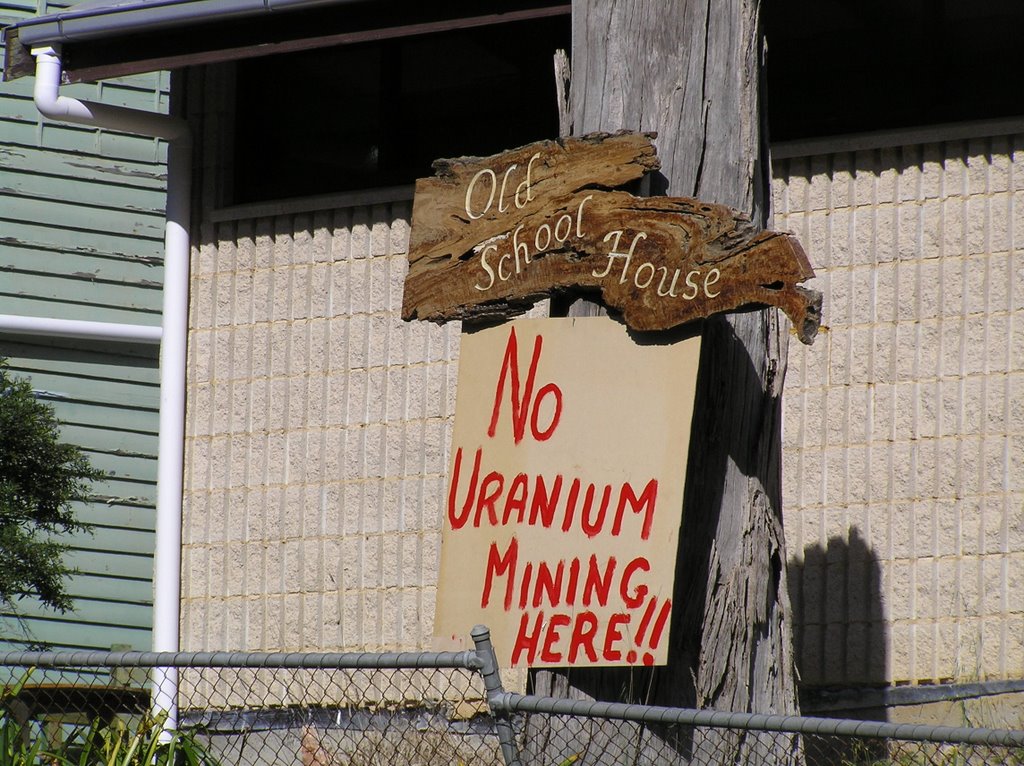
I took this photo today when I was walking in the Fleurieu Peninsula near the area where it was recently reported that uranium exploration would be taking place. Uranium was mined at Wild Dog Hill near Myponga for a time in the 1950s.

In a media release Premier Rann has pooh poohed the idea:


“Under Don Dunstan’s 1971 mining act companies have a legal right to explore,” Mr Rann said.

“However, this does not give companies the automatic right to develop or establish any mining activity without the approval of the Environment Protection Authority and the State Government.

“While I am Premier of this State there will be no uranium mining established anywhere near Myponga Reservoir.”


Marathon, the company concerned, has, according to the ABC, "moved to allay fears that the area would ever be mined".

That said, the reported comments of Dr Santich, the CEO of the company,

"Down there at Myponga we've known since we put in the application that it was highly unlikely that we'd ever get a permit to mine, even if we found what you call a viable deposit which would have to be massive and very rich...Nevertheless it's worth exploring, it's worth getting that knowledge."

suggest that we may not necessarily have heard the last of the matter.

04 October 2006

65 years on: another clue in the HMAS Sydney mystery?


Today the media, including The Australian , The Age and the ABC report on the exhuming of what may be the remains of a survivor (or a crew member) from HMAS Sydney which was lost in 1941 following an engagement with the German raider Kormoran.

The existence of the possible survivor's remains has been known for some time but only now have what may be his remains been re-discovered, afterthey were apparently buried in an un- or poorly marked grave on Christmas Island just before it was occupied by the Japanese in 1942.

Almost 65 years after the event many questions remained unanswered, notably how the Sydney could have been surprised by the Kormoran and why there were 317 survivors of the Kormoran
but none from the Sydney. This has given rise to continuing speculation about what really happened, for example whether survivors were killed by the Germans (or possibly the Japanese even though at the time they weren't at war with Australia but may have had a submarine in the vicinity).

The official view is summarised on RAN and Australian War Memorial websites. Some alternative theories are evaluated here.

In 1999 a Parliamentary Joint Standing Committee on Foreign Affairs, Defence and Trade reported on the loss of the Sydney. Here is the link to the full report. The Summary of Conclusions and Recommendations is here . It concurred with one author's opinion (prefiguring Donald Rumsfeld's on a broader range of issues) that much about the loss was "unknown and unknowable", but ended with a rousing but essentially hollow appeal to all parties:


The Committee is well aware that the level of interest in Sydney and her fate is so extensive that, regardless of the outcome of this inquiry, individuals and groups will continue to research the topic and expound on their various theories. This is to be welcomed, if it is undertaken with an openness to the information available and a willingness to listen and to take into consideration opposing views. ...The Committee strongly believes there is a need for all involved in the Sydney debate to move beyond animosity and antagonism and find common ground. No one group 'owns' Sydney, or has a monopoly on truth. The Committee hopes that in future researchers will rise above the personal acrimony and suspicion that has marred so much of the debate thus far. An exchange of differing views is a positive process, and can only lead to a better understanding of the events of November 1941. HMAS Sydney deserves no less.

Since then there have been moves to locate the Sydney's wreck, and an organisation Sydney Search Pty Ltd has been set up to do this. The Federal (($1.3 m), WA ($500,000) and NSW (($250,000) governments have provided or promised funding to assist with the search, preparations for which have gone quiet after a report in September 2005 that it would begin "within months".

Perhaps Tony Barrass the writer of today's Australian
piece could shed some more light on the topic. In July this year he wrote that "searchers are deady to start" though he also implied that the usual suspect of a funding shortfall was delaying things.


02 October 2006

Does the unadorned truth often prevail?


The many perceptive comments about the Hungarian Prime Minister's recent outburst of extreme candour include some from a local perspective, such as those of Matt Price and Bill Leak.

A-G's wake up call on torture


Yesterday on ABC TV's Insiders the Attorney-General Mr Ruddock, speaking from Washington, played his customary straight bat on several matters related to his portfolio, including a trial date for David Hicks ("needs to be dealt with expeditiously") and what constitues torture ("I don't regard sleep deprivation as torture").

In today's Australian Bill Leak has a cartoon titled "Humane torture" showing the AG as one man band (bugle, banjo, drum) demanding admittance to a Sleep Deprivation facility saying "I'm here to help...". Enough said?