13 September 2006

Free media?


Yesterday's Crikey referred to an article by
Richard Addis in The Guardian (UK) which ponders whether in 10 years' time all newspapers will be free. It's worth reading the whole piece for yourself, as it includes some rough calculations of costs and benefits. Addis suggests that the freebies are but a step on the road to fully online papers.

In Australia the free newspaper (many of them owned by News Ltd) has long been a feature of the suburban lawnscape, though it's not quite like London situation where the free papers have been used as bait to entice readers to fork out for a bulkier edition later the same day.

The costs of printing and distributing newspapers throughout our dispersed suburbs must be huge, and while a lot of people, including me, like to be able to hold something in their hand (if only to do the crossword puzzle or to have something to read on the bus) it may be that we can be weaned away from our reliance on print. After all I read bits and pieces of many papers on the web already.

Here in Adelaide both The Advertiser and The Independent Weekly have a free daily email each weekday which are sent out within minutes of each other to anyone who requests them. This competition doesn't guarantee that they'll report all the local news that's fit to email: yesterday neither reported the latest rumours about Mitsubishi, but it may be another indication of the way the wind is shifting.

That said, I think the home delivered newspaper will be with us for a while yet: perhaps even longer than 10 years. On my recent trip up north I was surprised that the weekday Australian costs $3.00 in Darwin and $2.20 in Alice Springs (and is not available at newsagencies in each place until the afternoon) . There are obviously people who are prepared to pay these prices and wear the delays (which can be even longer in more remote areas). Even so I'm surprised that a full text internet version isn't more widely promoted in those places: or perhaps it is and the tradition of the morning (or morning after) newspaper is still alive and well.


Alternative Prime Minister?


Just when I thought that Kim Beazley was starting to look and sound like an alternative PM he has made a fool of himself again. No, not over his assertion that the IR issue was the main reason why the Labor government was returned in Queensland (even though Laurie Oakes in The Bulletin has taken him to task for this), but over his idea (demand?) that everyone coming to Australia should have to sign on to an unspecified list of "Australian values".

Not only does this have all the indicia of policy made up on the run (as his predecessor was apt to do) but, as Matt Price in The Australian put it so pithily:

Having criticised Howard for dog-whistling on Muslim-bashing all these years, some Labor MPs are worried Beazley is sticking two fingers underneath his tongue and blowing hard.


One of the worried MPs, judging from her comments on last night's ABC TV Lateline, would be Julia Gillard . Only the transcript of her interrogation by Tony Jones is available: a video would show how she just managed to maintain her poker face for the duration of a longish interview.

Come on, Kim : you need to do better than this.

England selects


The squads for the English cricket tour of Australia have been announced. Injuries have ruled out Michael Vaughan and Simon Jones, while there seem to be some doubtful starters, eg
Ashley Giles who hasn't played for months, among those who have been selected. The selectors have prudently named a backup "Academy" squad which will be based in WA as a kind of travelling replacement pool.

I wouldn't write the English off so far in advance but on paper the team looks weaker than that which won the Ashes last year: the only possible improvements I can see are (assuming Read is preferred to Jones)
in the wicketkeeping
and maybe (if Giles is unfit and Panesar can spin the ball as he's done recently) the spin bowling. I won't make any further predictions, but will hope for a competitive series. England should be able to give Australia a good run for its money, but whether it can do enough to hold on to the Ashes (ie at least draw the series) is another matter.

11 September 2006

Five years on


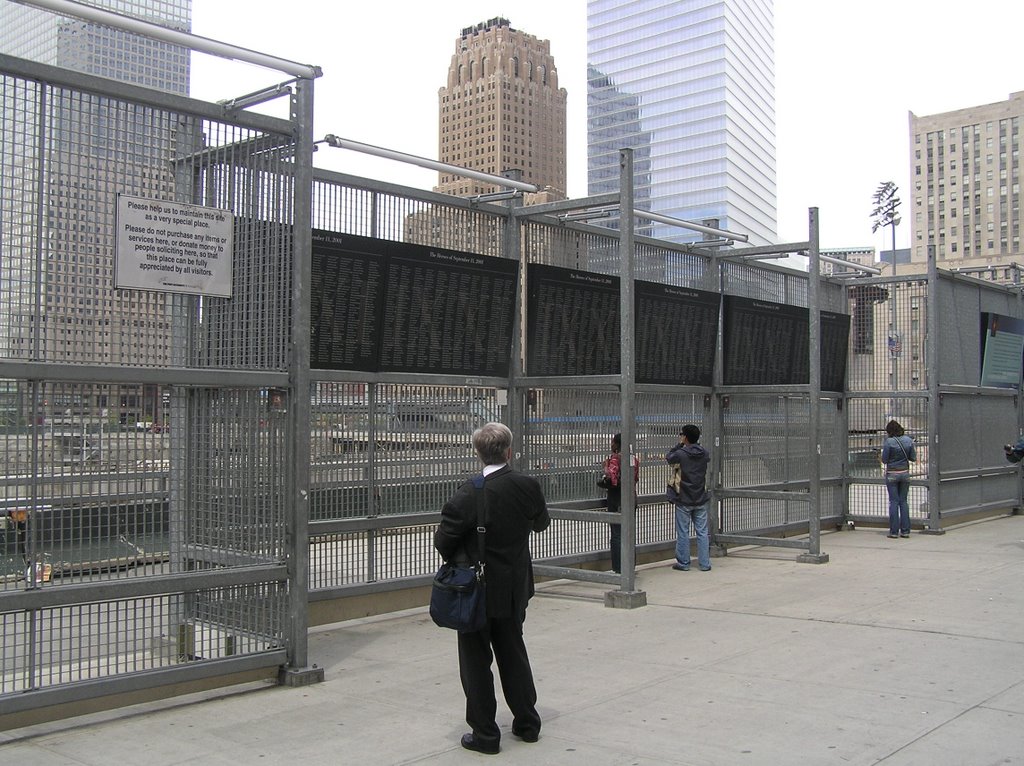
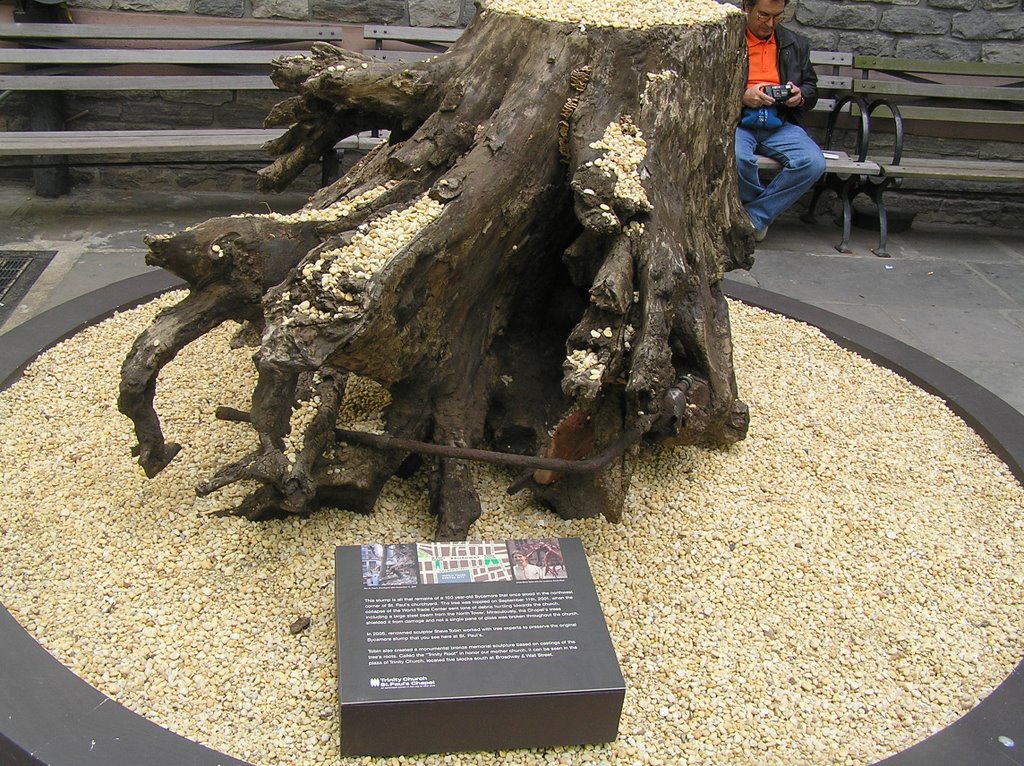
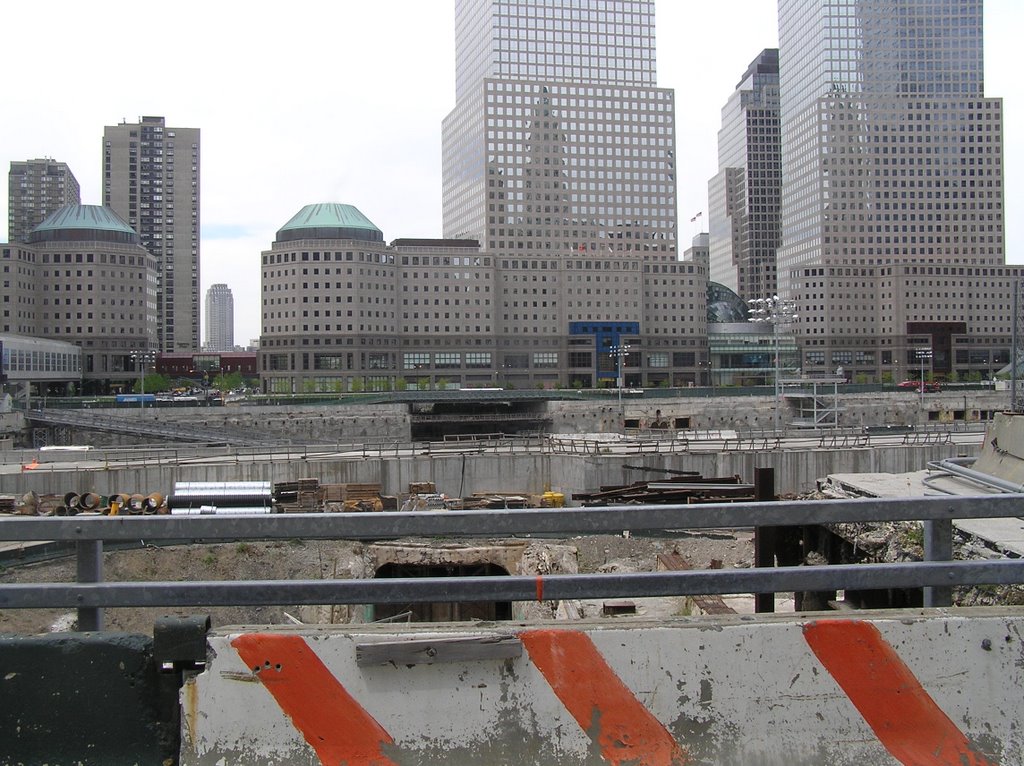
Almost every western media commentator has had, it seems, something to say about the fifth anniversary of the attacks on the World Trade Centre. I don't have their analytical ability but, as I did visit the site earlier this year and took the photos above, I will post my one cent's worth .

Two pictures are of the site itself; the other two are of an adjacent churchyard dating from the 18th century (Ground Zero can be seen in the background of one of them) which was largely unscathed except for a tree uprooted by the blast.

When I was there I paused to reflect upon the destruction and the loss of life. I have never been in a place where so many innocent - and, despite what others may say, they were innocent - people have died at one time as a consequence of the actions of other humans. I know that there have been many other "occasions" (an unsatisfactory term, but I can't think of a more appropriate one just now) where there has been greater loss of life, but I will always remember my visit to Ground Zero and hope, though am too cynical to expect, that there will never again be deaths on this scale.


10 September 2006

GNE 2006


Summary of journey [added to blog July 2007 from notes taken at the time].

Day 1

Adelaide - Coober Pedy via Stuart Highway.
880 kms

Day 2

Coober Pedy.
34 kms

Day 3

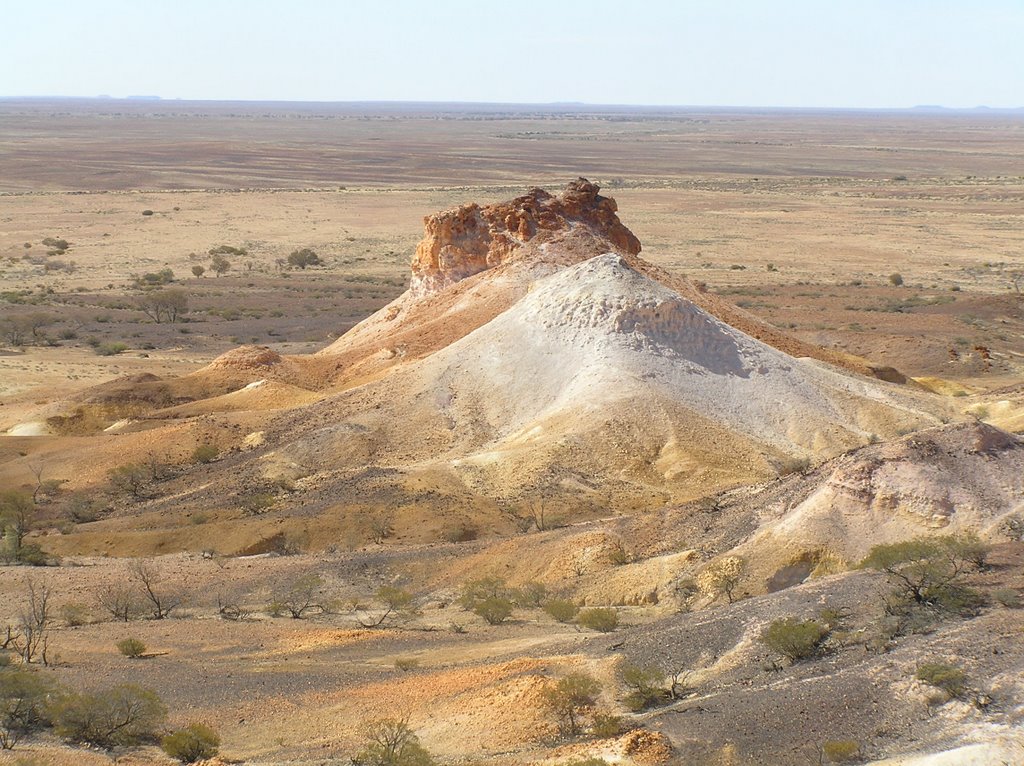
Coober Pedy - Breakaways (see photo).
82kms

Day 4

Coober Pedy - Alice Springs via Stuart Highway.
713 kms

Day 5

Alice Springs - Renner Springs via Stuart Highway
690kms

Day 6

Renner Springs - Dunmarra (Stuart Highway)
206 km
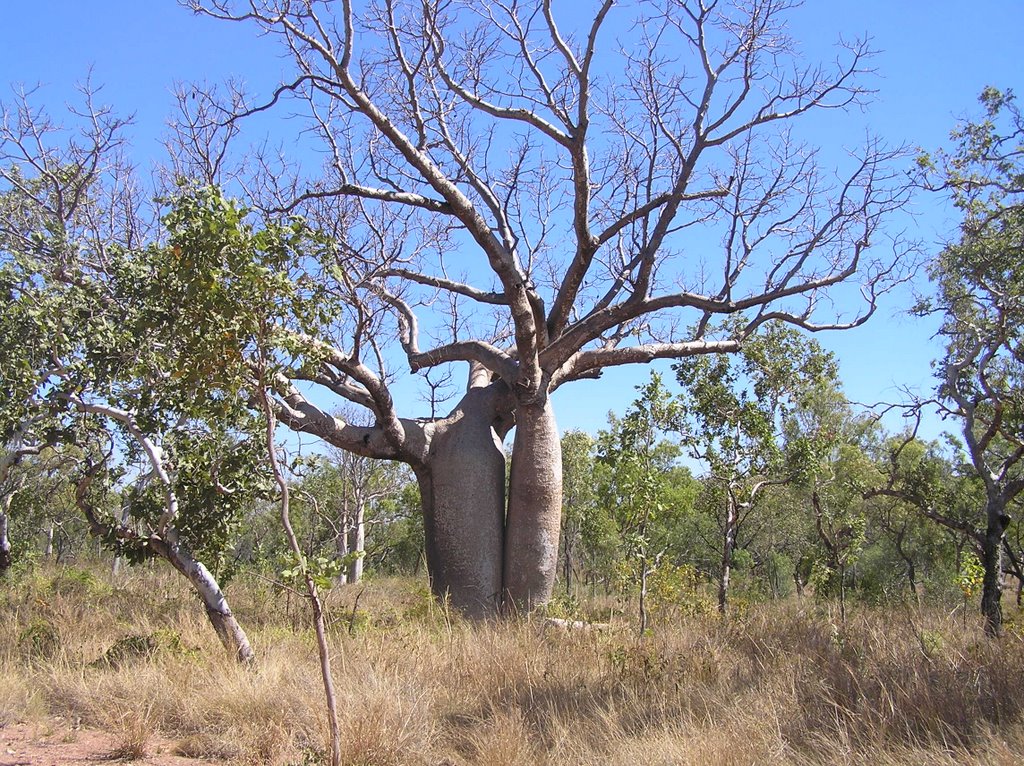
Buchanan Highway (see photo of road train) - Top Springs - Victoria River Downs (pass) - Victoria Highway - Gregory National Park (see photo of boabs)- Limestone Gorge
476 km
Total for day:682 kms

Day 7

Walked to East Baines River through washed out area.
Drove Limestone Gorge - Timber Creek - WA border (zealous quarantine inspection) - Kununurra.
297 kms

Day 8

Kununurra - Wyndham and return (see photo of me dipping foot in water).
255 kms

Day 9

Kununurra - Lake Argyle/ Ord River Dam - Gregory's camp - Timber Creek - Sullivan Camp (Gregory NP) (many flies but Hobson's choice).
435 kms

Day 10

Sullivan Camp - Katherine - Edith Falls Nitmiluk NP (first safe swimming spot on trip).
247 kms

Day 11

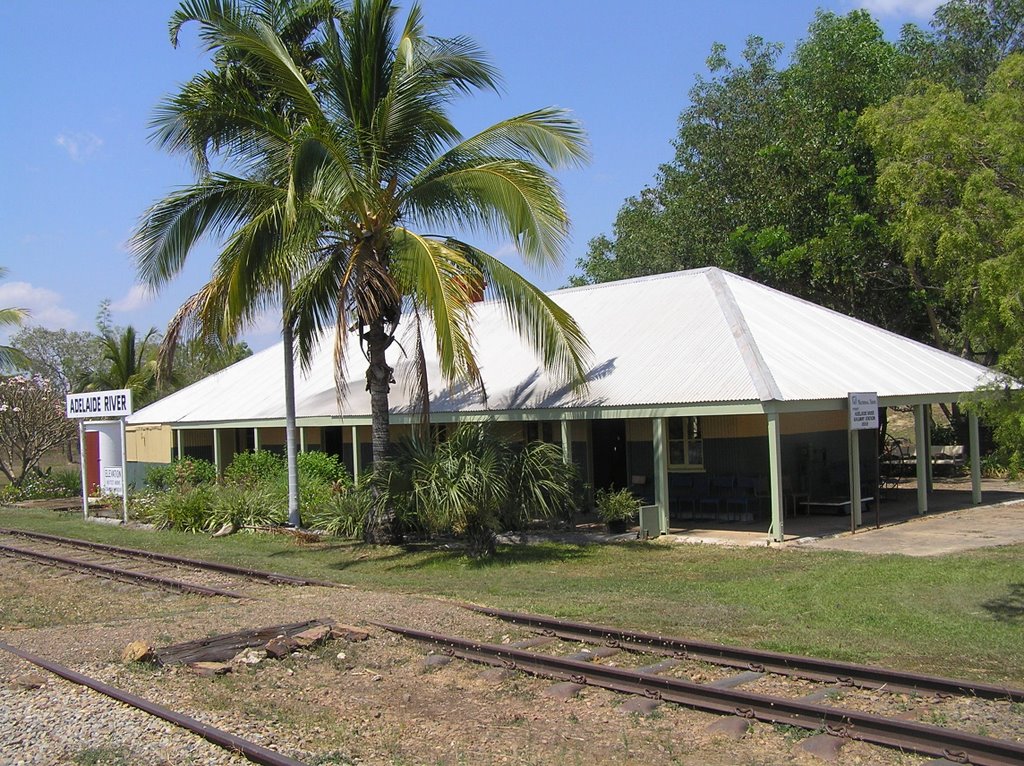
Edith Falls - Pine Creek - Adelaide River (see photo of station) - Batchelor ( car cooling system problem required rescheduling of proposed trip to Litchfield) - Howard Springs.
326 kms

Day 12

Howard Springs - Palmerston for car repairs; I took bus into Darwin. Collected car in pm.
33kms (car)

Day 13

Howard Springs - Batchelor - Florence Falls, Litchfield NP (resuming planned itinerary). Car clocked up 130,000 kms near Elizabeth River.
126 kms

Day 14

Litchfield NP tour: Buley Rockhole, Tolmer, Wangi (walked above waterfall).
67 kms

Day 15

Florence Falls - Batchelor - Snake Creek Railway remains - Pine Creek - Edith Falls.
282 kms

Day 16

Edith Falls - Katherine - Mataranka Homestead (near thermal pool).
181 kms

Day 17

Mataranka - Larrimah (Stuart Hwy); Larrimah - Birdum (rough track following railway line) for Birdum 2006. As in 2005, a most interesting group of people.
92 kms

Day 18

Rode the NAR (see photo), then drove Birdum - Larrimah (rough track), then back onto Stuart Hwy; brief diversions to Daly Waters and old Stuart Hwy near Banka Banka otherwise on to Tennant Creek (Outback Caravan Park - v good).
520 kms

Day 19

Tennant Creek - Stuart Hwy - Alice Springs (spent c 2 hrs there inc quick visits to Old Ghan and Road Transport museums - both worth seeing) - SA/ NT border. Camped with ( as I calculated) my head in NT and legs in SA. Among campers were a French couple cycling south.
831 kms

Day 20

SA/ NT border - Coober Pedy.
414 kms

Day 21
Coober Pedy(dep 0655) -Port Augusta via Stuart Hwy - Wilmington - Melrose - Clare - Adelaide (arr 1907).
896 kms.

Total trip: 8083 kms.


07 September 2006

Colin Thiele


Colin Thiele died on the same day as Steve Irwin and thus his life has not been commemorated to the extent that many, particularly we South Australians, might have expected.

I'm not in any way belittling Steve Irwin, but I knew Colin Thiele. Many years ago I was a student at the teachers college where he was a lecturer and was impressed not only by his ability to evoke South Australian life and landscapes in his writings but also by his willingness to give his time to encourage others to read, and not just his books.

His passing is sad, but his substantial body of work will remain, as will the fond memories of people such as me, those who have sent letters to The Advertiser, and many more whose minds have been stimulated and enriched by reading his books.


Resumption of service


Yesterday evening I returned from GNE2006, after driving all day from Coober Pedy. Watch this space for more details of the trip, and for more frequent postings on other matters.


15 August 2006

'Tiser keeps abreast of the times


There's an identity crisis in the Adelaide media, or at least that large chunk of it owned by News Ltd. The Advertiser has recently revamped and renamed its website Adelaidenow (no space between words). This is the only website of the News metropolitan dailies which has changed its name from that of the parent paper. Notwithstanding this, Adelaidenow is offering a free subscription to the (online only) " Advertiser PM Edition" (or "edtition" as the home page describes it ).


Adelaidenow or Advertiser? Is this a marketing exercise designed to gauge the interest in a separate online infotainment daily (which, as Adelaidenow does, can draw its stories from all over the News empire) or is it evidence of in house divisions in the city where Mr Murdoch began his rise to global ascendancy?


13 August 2006

A community event


This week is the hard rubbish collection week in my street. The council gives residents the opportunity to discard unwanted items which are too large to be taken in its regular collections. The items are supposed to be put on the kerb between noon on the Saturday and 7 am of the Monday of the relevant week. What also happened today is that people, both residents and outsiders I'd guess, toured the area looking for items for which they might have some use. I put out a settee and a lounge chair , and they were snapped up by a person further down the street, who in turn put out a floral lounge chair. I've not checked to see if it is still there.

This scavenging, and that word with its negative connoations doesn't seem quite right has become a local custom, and one to which little if any stigma is attached. It gives neighbours something to talk about, and more of them do stop to talk about it and some, such as my next door neighbour, act informally to assist potential collectors. I believe that it provides a modest form of community strengthening: by doing our bit to tidy up our own homes we sometimes even help our neighbours in unexpected small ways.

10 August 2006

Advertisers out of step with reality


As the media, including the BBC , Aljazeera and news.com.au report, air travel to and from UK airports has been disrupted by what the BBC describes as an "airlines terror plot".

A common thread of all reports, supported by references to and pictures of chaos at Heathrow, is that intending travellers should defer travel if possible or otherwise be prepared for long delays and extra security precautions, including restrictions on cabin baggage (which seem to extend to personal reading matter).

As I seek more information on the subject, the advertisers who fasten on to my searches seem oddly inappropriate, to say the least. Here are some example of "sponsored links" (sponsored not by me needless to say):

Airport London Taxi (LHR)Transfer to and from (LHR) Pay a Fixed Price 0870 38 99 777
www.minicabhire.com

Chauffeur London Airports

Luxury Mercedes in South East UK 1st Class Taxis at Great Rates
www.mercury-travel.co.uk

Airport Transfers London

London airport transfers by minibus, chauffeur or coach
conciergedesk.co.uk

Heathrow Flights

Compare cheap flight deals to Heathrow from top airlines.
Heathrow.OneTime.com

08 August 2006

Census: room at the internet


Tonight I completed my census form on the internet. I wouldn't have been surprised had the census website collapsed under the pressure applied by the estimated 1,000,000 others doing likewise, but it didn't. Whether this was because fewer than expected chose this option or because the system had been built strong enough to carry the load, or whether others have had a different experience, I don't know, but I'll give credit where credit is due and say "Well done ABS".


Fourth test snippets


Where there's mucking about there's money

I'm listening to the BBC radio online description of the Headingley England v Pakistan test. Because the game was evenly poised at the start (though is no longer as I type with Pakistan 5/84 at lunch chasing 300+) a good crowd turned up but caught the ground authorities napping.

The BBC invited the Yorkshire secretary to explain why so many people willing to pay 15 quid ($38) to get in had to wait for so long to do so. His explanation was bizarre: each ticket had to be sold individually, and then the stubs reconciled, presumably while the queues inched forward.

I'll be interested to see how widely this bumbling is reported elsewhere in the British media.

Sun's cricket man gives soccer a boost

In the lunchtime discussion a panel including John Etheridge, the Sun's cricket writer (is "correspondent" too multisyllabic a term for that paper?), ruminated about various matters sporting. In the course of conceding that this northern summer's cricket season hadn't grabbed the public's imagination as last year's had done, Mr Etheridge actually referred to the world game as "soccer". I hope that all the people in Australia who have insisted that the game be called "football" take note.


Mud soup in Guantanamo: on the Cuban side of the wire


Despite my criticism of the practices allegedly condoned by the authorities supervising the US "facility" at Guantanamo Bay I'm not entirely blind to the shortcomings of the Cuban regime on the other side of the wire. Spiegel Online (English version) reports how the regime treats dissidents, for example "
A former detainee of a jail in the Cuban city of Guantánamo recalls that the drinking water was so muddy you had to wait for the sand to settle before drinking it."


07 August 2006

The man who wasn't there


Today's Australian "Cut & Paste" section (p15, not online) prints an excerpt from what appears to be a review on ABC Radio National by Imre Salusinszky of "Honour Bound", a "theatrical performance based on the imprisonment of David Hicks". The excerpt includes these comments

David Hicks doesn't present himself automatically as a subject for these performances. Artists have to accept responsibility for the choices they make, and I think this one is not just out of touch with the Australian community, but somewhat offensive, given what international Islamism has done to us.

We all say that al-Qa'ida is the enemy and we have to flush them out before they kill again, yet we choose this one man, who admits to being in al-Qa'ida and, because he has an Australian passport, make him the focus of protests and petitions and films and plays. There's a great inconsistency here.

Mr Salusinszky did indeed say these words on the arts program The Deep End (audio still available) last Thursday. What
The Australian didn't say (apart from that Mr S is its NSW political reporter) is on the program website: "
Imre Salusinszky hasn't seen Honour Bound as yet - but he's got some strong views about putting the story of David Hicks on stage."

In its arts pages today the paper does print
a review of Honour Bound
"Hicks's jail tale triggers passionate response" by John McCallum, who appeared with Mr S on The Deep End discussion.

It's clear from his descriptions of the action

In a vast steel cage, six performers, choreographed superbly by Garry Stewart, are surrounded by projected texts and video, enveloped in sound and voices, and awash with harsh, shredded light as they fly, hang or turn in the air, crashing against the bars, floor or each other and dance violently, abjectly or tenderly around this frightening, nightmarish space"

that he has actually seen the piece, though he acknowledges that


Because David Hicks has become such a powerful symbol -- a monster, a victim, a terrorist, a martyr, depending on who's talking -- it will anger and upset different audiences for different reasons.

Now that his piece has been mentioned in The Australian I wonder whether Mr S will be clarifying that he didn't see the performance. Somehow I doubt it.


04 August 2006

Stop it, you'll go bland


Today in Spiked Frank Furedi explores the event to be held in London tomorrow which will bring into the open (and to the nation's television screens) a practice which has hitherto been " associated with sad old men wearing dirty raincoats".
He continues "now it is no longer seen as a sordid exhibition, but rather as an exercise in raising awareness about safe s-x." In keeping with the best traditions of political correctness doing drugs, drinking alcohol and smoking will be forbidden, while the event will be open to "people of both genders and s-x-al orientations", though people who exhibit "prejudice, disrespect and intolerance of other people" will be blackballed, ...er... sorry, asked to leave. Libertarians need not completely despair: fully clothed people will not be allowed into the rooms set aside for the competition.

What is this practice? If you've not deduced the answer already, read the article.

Levity aside, Furedi makes many pertinent points, not just about the subject of tomorrow's event. Take this for example:

In recent decades, intimate relationships between people appear to have become more complicated. The expectation of failure and of instability surrounds the institution of marriage, even of cohabitation. It is now common for people to approach their private relationships with a heightened sense of emotional risk. Popular and academic culture contributes to this process: it helps to legitimise our insecurities regarding the possibility of finding love and experiencing fulfilling and passionate relationships.

Today’s ‘therapy culture’ transmits clear signals about ourselves and our attachments to others. We are continually instructed to attend to our own needs in order to fulfil ourselves. Even happiness is discussed as a problem if its realisation depends on others. Indeed, feelings that distract individuals from the goal of self-fulfilment are often defined in negative terms. That is why in many self-help books the feeling of love, especially of the intense and passionate variety, is treated as a problem. Although love is portrayed as the supreme source of self-fulfilment, it is also depicted as potentially harmful because it threatens to subordinate the self to another. The passionate feeling of love towards another person is represented as destructive and dangerous.


03 August 2006

Gratuitous comments about community standards


In today's Crikey (not online) Misha Ketchell reports that The Age's policy of reimbursing the cost of meals consumed by its restaurant reviewers no longer extends to the reimbursement of gratuities paid by the said reviewers.

After pointing out that The Age is the odd person out in the Fairfax media in this respect , he goes on to argue that in Australia there is a "community standard"of a "modest tip, usually of between 5 and 10%.
To unilaterally absolve oneself of this obligation is a bit like declaring you're no longer obliged to stand up for the elderly on public transport."

IMO this is balderdash: the Australian practice, custom, community standard, call it what you will, is that tipping in restaurants is not obligatory, though it may be voluntary eg where a higher standard of service than expected has been provided , or where a group of people have chipped in to cover the cost of their meal and there is some change left over. If tipping is accepted as a "community standard" we won't be far away from the situation common in UK, and perhaps other countries, where an "optional" or "discretionary" service charge (in my limited experience usually 12%) is added to bills.


02 August 2006

Britain doesn't waive rules on rubbish


The UK Daily Mail has recently reported some bizarre examples of the British nanny state in action.

They include instances of children arrested for climbing a tree and cautioned for playing hopscotch in the street.

The authorities have also not gone soft on adults who break the increasingly prescriptive laws.
Putting rubbish out early is now an offence, while residents who fail to prevent local fauna from disturbing their rubbish or who put junk mail in a public rubbish bin instead of their domestic one have been threatened with fines.

At least a small measure of commonsense seems to have prevailed in the case of the woman who was
charged with
putting her rubbish in the wrong bin : she was acquitted after refusing to pay the fine.

I try to do the right thing with my waste, which is put into wheelie bins for collection, but I'll be even more vigilant now in case my local council tries to enforce crackbrained rules like these.

01 August 2006

Farewell VHS movies


Today I culled my collection of VHS movies and consigned most of them to the bin to await tomorrow's collection.

I've already replaced many of them with DVD copies, which take up less space and are easier to operate. I particularly like those with extras such as directors' commentaries and English for the hearing impaired subtitles (my hearing's not bad enough to qualify for the DSP but I occasionally miss a muffled comment or two).

I'm always on the lookout for new DVD releases (and rereleases), both local and international, though I'm annoyed by regional coding(what's happening to it under the Aust-US Free Trade Agreement?) which puts barriers in the way of Australians who want to buy DVDs available elsewhere.

I'd also like to see more reviews of DVDs in the media. The SBS Movie Show has IMO been unfairly terminated but its ghost lingers, at least for the moment, on the program's website. ABC TV's otherwise worthy At The Movies doesn't deign to review DVDs, which leaves the local street mag Rip It Up and Lawrie Zion's "Letterbox" column in The Weekend Australian as my principal sources of information on new DVD releases. Unfortunately neither the mag's reviews nor Lawrie's column are online.

Last weekend's, Lawrie asked his readers to nominate movies which aren't available on DVD, either because they've never been released or are no longer available. A brief look at IMDb will reveal many films, eg the Charles Chauvel Australian movies Jedda and Sons of Matthew and world cinema greats such as Satyajit Ray's Charulata , which are not available in that format, even though many of them are or have been available on VHS.

I'll be getting in touch with Lawrie and adding my five cents' (or more) worth. If you have your own suggestions you can contact him at lawrie.zion@bigpond.com


30 July 2006

Matildas lose in yet another penalty shoot out


In the final of the women's soccer Asian Cup China has defeated Australia (the Matildas) in yet another penalty shoot out. While the game seems to have been played in a good spirit, unlike the semi-final between China and North Korea , IMO once again the way the result was achieved shows the limitations of the inherently low-scoring sport which is soccer/football. Surely someone can come up with a better idea? What about suspending the off-side rule if extra time is played?


Census time


The local census official came by today with my form, which reminded me that 8 August, the census day (more accurately night), is nigh.

I've seen an ABS TV commercial featuring Ernie Dingo at a Brisbane railway station and a newspaper ad with a message of support from a number of corporations, but otherwise there seems to have been little discussion about the census. I recall that at previous census times there has been a fair bit of discussion about some of the questions asked, and the privacy aspects. Are we now more inured to government statistical gathering, or are there too many other matters preoccupying us at present?

I have one observation: the form is relatively long (18 pages); and one question: how far in advance of census night can you fill it (or parts thereof) in?

29 July 2006

Tram extension to run ring around inner city


Adelaide Now (the revamped Advertiser/ Sunday Mail website) has a photo of Ministers Conlon (Transport) and Lomax-Smith (Tourism, City of Adelaide et al) announcing the extension of the Adelaide- Glenelg tram line to an as yet undetermined ring route (a couple of options are outlined) around the inner city.

Not surprisingly, and not without some justification , Minister C has come out fighting and attacked "small-thinking " critics of the proposal, which is estimated to cost $31 million. The small thinkers aside, the Minister's problems with his handling of the Transport portfolio have been further exacerbated by a dispute over the purchase of two 15 year old buses from Brisbane. As the effective life of a bus in Adelaide is deemed to be 25 years by this standard there's some service left in these acquisitions, but I wonder how good the oversight of our public transport system is if we have to rely on non-airconditioned, non-wheelchair accessible hand me downs. How many 25 year old cars are still running on our roads?


28 July 2006

The Australian Foreign Legion(s)


I expected more media comment about the matter, but only Michael Pascoe in Crikey (not online) of those I've read draws attention to the different official and media attitudes to two Australian citizens: Asaf Namer, who was killed while on active service with the Israeli army (he was also an Israeli citizen); and David Hicks, who continues to languish in Guantanamo Bay.

Sgt Namer's death, like every other one in the present undeclared war, is regrettable, yet it has brought to light that, according to the Sydney Morning Herald, "
dozens of Australian soldiers serving in the Israeli Army and hundreds who are eligible to be called up for compulsory reserve duty".

The story headline "Serving here is part of our Australian heritage" raises some very interesting questions, including what mght happen if and when, as News.com.au reports, a UN peacekeeping force including Australians is formed and it meet s Australians serving in the Israeli army. The RSL might have a view about Australian citizens serving in the armed forces of a foreign country, even one to which we are not unfavourably disposed. It does set a precedent for future situations. How many Foreign Legions will Australian citizens be allowed (or encouraged) to serve in?


Update 29 July

Today's Weekend Australian has an article"Aussie passed up desk job for front line" and several letters reflecting a variety of perspectives about Sgt Namer, including one drawing a comparison with the Hicks situation. The article refers to "
Australian-Israeli army spokesman Guy Spigelman", an ambiguous though not inaccurate description , who confirmed that "more Australian-Israeli dual nationals could be called up to fight in the war, with between several dozen and 100 already on active service in the Israeli Defence Force."

This was juxtaposed with a comment from the (Australian) Prime Minister who "said he did not have a problem with Australian dual nationals fighting for Israel because they were fighting for that country's armed services. But he said if Australian citizens attempted to fight for Hezbollah they could be breaching the law. " Perhaps Mr Howard should clarify the first part of his statement in case it comes back in another context to bite him. As for the second part The Age reports that the PM is awaiting further advice to see whether, because Hezbollah is banned under our counter-terrorism laws, Australian citizens who fight for it are breaking the law.

The Age also reports that Attorney-General Ruddock expects David Hicks to be put on trial "soon", a claim which is taken with a pinch of salt by David McLeod, Hicks's Adelaide based lawyer. The paper also prints several letters on the Lebanon situation in general and the foreign enlistment aspect in particular.


25 July 2006

Death in the workplace not an industrial accident?


Today I heard ABC Radio News report the death of a man working at the Adelaide Brighton Cement works at Birkenhead, near Port Adelaide. Unfortunately the ABC news website did not report it. Adelaide Now , the new name for The Advertiser's revamped website, mentions it briefly, describing it as "an industrial accident" with "no suspicious circumstances".

The fullest description online comes from Indaily TheIndependent Weekly's daily email news service. The headline "Contractor crushed to death by truck at cement plant" is a succinct summary which is fleshed out by a report including the chilling statement that "Police will prepare a report for the state coroner because the death was not deemed an industrial accident".

If this was not an industrial accident, then what was it? Surely anyone who is killed or injured on a worksite while undertaking work connected with the workplace should be counted in the statistics of industrial accidents. If the law says otherwise then, at least in this situation, the law is an ass. I offer my condolences to the family and friends of the deceased.


23 July 2006

Where the.....are you?


The Weekend Australian Magazine has announced the winners of the "Wish You Were Here" photographic competition which it has been running in conjunction with Tourism Australia.

The photos of the winners and finalists can be seen here.

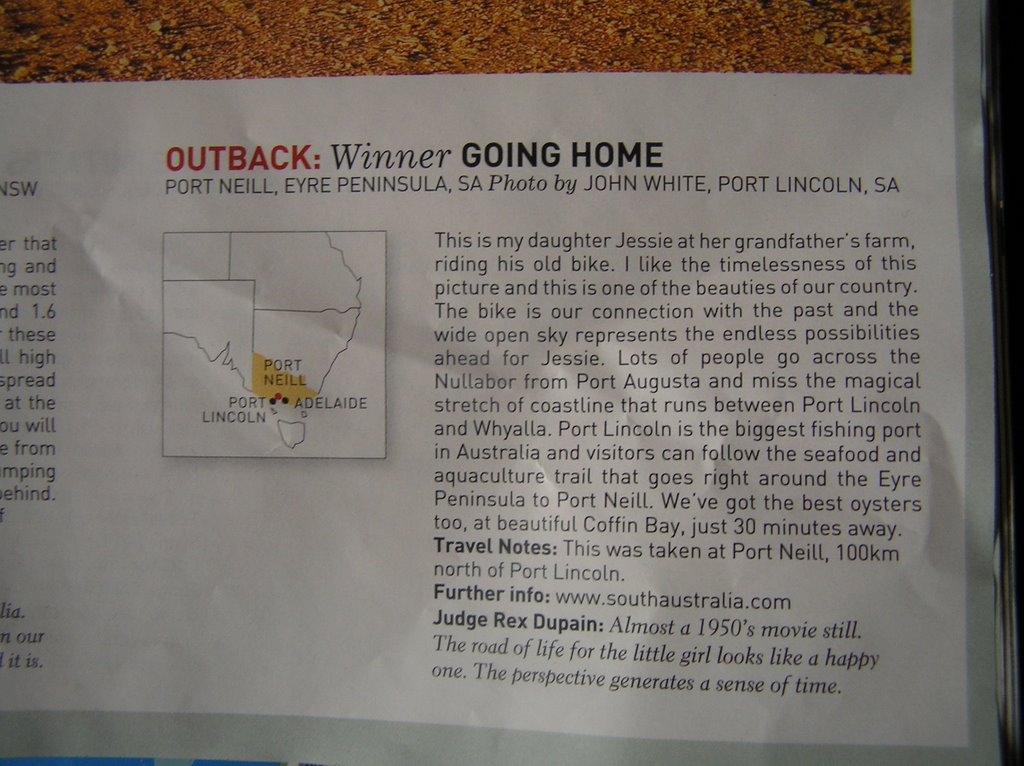
The winner of the Outback category was a photo taken in Port Neill, South Australia. The paper has published the four winning entries together with a caption and location map for each. The map purporting to show Port Neill's location is almost unbelievably erroneous. First, South Australia is confused with Victoria, then Port Neill is placed at the head of Port Phillip Bay (ie where Melbourne is), with Port Lincoln located in the vicinity of Geelong, and Adelaide marked as a south eastern suburb of Melbourne/ Port Neill.

Fortunately the map doesn't appear on The Australian or Tourism Australia's websites. In case you can't get hold of a copy of the paper to check that I'm not pulling your leg, I've taken a snapshot of p27 showing the map and caption.

I wonder whether, and if so from whom and when, we will see a correction. The photographer has, like the other three winners, won a luxury holiday and a new camera, but deserves better than this.

22 July 2006

"We learn from those with whom we disagree"


In yesterday's Australian Frank Devine discusses the views presented by Owen Harries, who supported Australia's involvement in the Vietnam War but who has opposed its involvement in Iraq. Devine's position on each is the opposite of Harries's. Apart from the substance of the two arguments it's unusual these days to see one person criticising another's views so politely. Perhaps it's easy for me to say this because I agree with parts of what each of them says, even if I'm more inclined to agree with most of Harries's seven points (read the transcript for yourself t see them).
As Devine, quoting Geoffrey Blainey, acknowledges "we learn from those with whom we disagree".

One media organisation, two views


Posting on the BBC's The Editors blog Richard Porter reflects on two quite different versions of the BBC midday news coverage on Thursday of the evacuations from Lebanon. One, BBC World (Mr Porter's department), focused on the international aspects of the evacuation and drew attention to "a
rising chorus of experts who have raised the question of international humanitarian law". The other, the domestic BBC News 24 channel, depicts the evacuation through Union Jack-tinted spectacles: there is no indication that nationals of other countries were also seeking evacuation.

Porter comments


It's a great thing about the BBC that we have sufficient editorial independence to be able to make these decisions. Both, in their own way, are very focused on the audiences served by the programmes. Neither (in my view) is more correct than the other.

This blandness raises more questions than it dodges. While the BBC does have, as he later states, an obligation to keep British citizens informed of the evacuations, focusing so closely on the British perspective makes it harder for the listeners to get a feeling for the context in which they are taking place, and may in consequence increase rather than allay fears.

Fortunately, like the good BBC person he no doubt is, Porter recants a little at the end of the post:

The challenge for us - whether we be serving domestic or international audiences - is not to lose sight of all the issues. It's complicated; it's changing rapidly; opinions are strongly-held on all sides and need to be properly reflected. So even if we spend a few hours of one day focusing on one aspect - such as the British evacuees - we must make sure that over time we keep coming back to the core questions. What's happening now? What caused this? What's going to resolve it? And many others...


This is a good summary of why I turn to the BBC so often as a major source of my international news.


20 July 2006

An almost overlooked anniversary


To its credit The Australian recently published an article by Ross McMullin on the Battle of Fromelles, "the worst 24 hours in Australian history" , as he described it.

An extract:

On July 19, 1916, Australian soldiers participated in their first significant operation at the Western Front, near the French village of Fromelles. It was a disaster, with 5533 Australians becoming casualties in one night. Our casualty toll at Fromelles is equivalent to our total casualties in the Boer War, the Korean War and the Vietnam War put together.

It was not just the worst night in Australian military history. Tomorrow [19 July] is the 90th anniversary of the most tragic 24 hours in Australia's entire history.

The Fromelles fiasco lacked the slightest redeeming tactical justification. It was conceived as a feint. The idea was to deter the Germans from transferring units from Fromelles to the Somme. But the plan was gravely flawed.


Yet another reason why the ABC is important


If you get a chance, listen to Philip Adams's Late Night Live discussion with Anwar Ibrahim, the former Deputy Prime Minister of Malaysia, now Professor: see link for how to download.

The topic? Shakespeare.

IMO this is top notch stuff as it explores issues which, I suspect, many of the media blowhards who lament the decline of Shakespearean studies in schools etc would have difficulty comprehending. As Adams and Prof Ibrahim agree, one of Shakespeare's outstandinfg qualities is his ability to present both sides of a question (this was also discussed in a LNL program last week).

19 July 2006

Sunk but not located: more on HMAS Sydney


Today's Australian has a story about HMAS Sydney which was sunk somewhere off the Western Australian coast
in November 1941, apparently by a German raider Kormoran acting alone. Because no Australians of the Sydney's 645 complement survived, while about 320 of the Kormoran's did, some questions have been raised about the exact circumstances of the former's demise. Some have alleged that a Japanese submarine was involved (bear in mind that this was a few days before Japan entered the war) , that the Sydney survivors were machine gunned in the water and that the Australian government concealed all the evidence.

The Australian has found a 92 year old ex-Kormoran officer, Reinhardt von Malapert, living in Chile. He has offered to help locate the Sydney's resting place. A consortium including David Mearns, described by the paper as "the world's leading shipwreck hunter", and a non-profit organisation HMAS Sydney Search Pty Ltd, is seeking additional funding to proceed with the search. They have already received $2m support from the Federal, WA and NSW governments but, according to another report (not online) on p5, need an unspecified additional amount.

Rumours about the fate of the Sydney's crew (as opposed to the ship itself) have abounded for years. While locating the wreck may not answer all the questions, it may fill in a few more pieces of the jigsaw. I therefore support the search for the Sydney's wreck. I'd even be prepared to make a modest donation to HMAS Sydney Search Inc if they contacted me.

18 July 2006

Expletive not deleted


The BBC website prints the text of President Bush's "unguarded chat", as the headline coyly describes it, with Mr Blair which was picked up by both sound and video equipment. You can view it by following the links on the website. There's been some comment about the President's speaking with his mouth full and even more about his use of an expletive, which by contemporary standards is very mild, yet I'm not sure what to make of his often indistinct assessment of the situation (and by this I mean not just what's on the transcript but also his other pronouncements).

How strong is his grasp of the situation? Is he capable of playing a leading role in stopping the killing and destruction as soon as possible? Beyond that are the key parties able to sit down and talk and try to work out a settlement based on acceptance of Israel's right to exist and implementation of UN resolution 242? It will be hard enough to stop the fighting, let alone make any progress towards a settlement, and I am not confident that much will happen beyond restoring a tense truce.

Just as I'm about to post this I've checked the latest BBC online news again. The headline "Glimmer of hope for Mid-East diplomacy" isn't really borne out by the text which follows:

Diplomacy is gearing up slowly in the Middle East crisis and its intention is not just to end the immediate conflict but to help prevent future ones.

In fact, until future arrangements are agreed it is unlikely that there will be a ceasefire at all.

There is a recognition among many countries that a ceasefire alone will not be enough.

Israel is determined not to go back to the status quo and Israel is one of the parties calling the shots. Ideally, it would like Hezbollah to be disbanded but certainly moved back from the border in a much reduced state.

Getting any agreement or understanding will take time during which Israel will continue to strike at Hezbollah, mainly by artillery and from the air.

It is therefore using the delay in diplomacy to carry out its aims and it appears to have the support of the United States.

........................

The key to any solution, in the view of Western officials, is the phrase in the statement issued by the G8 meeting in St Petersburg on Sunday. This said that "extremist elements and those that support them cannot be allowed to plunge the Middle East into chaos".

This was a reference to Hezbollah and to the two countries that support it, Syria and Iran.

The way to a restoration of peace, therefore, might lie through the door to Damascus. The aim would be to get some arrangement under which Hezbollah is restrained in southern Lebanon, thereby allowing the Israelis to stop their campaign.

Another "long-term arrangement" has been suggested by UN Secretary-General Annan and Mr Blair: this involves beefing up UNIFIL, the 2,000 UN troops already in Lebanon. Yes, that is correct, but don't ask me what they're doing. They're supposed to be a "monitoring force": monitoring what I don't know.

Given the track record of other UN "peacekeeping" forces, eg in Rwanda, You wouldn't want to put too much money on them to do more than hold the ring for a short time. I shall nevertheless keep watching the situation and hope for the best (ie least bloody) outcome.

Update 20 July

The Times(London) discusses President Bush's "gangsta rap summary" of the Middle East situation.

The Australian has an article by Rebecca Weisser which, among other things, claims that "the ABC looks balanced compared with the [Sydney Morning] Herald".

If you think the ABC's balance is in question check out the trancript of last night's Lateline discussion with Tony Jones, Ted Lapkin and Antony Loewenstein. I won't comment on it.


Outstanding leadership for younger players


"Redbacks retain Lehmann as captain" reports ABC local news.

The report continues:

South Australian Cricket Association chairman of selectors, Paul Nobes, said Lehmann had provided outstanding leadership for the Redbacks' younger players. "We believe that Darren is the right person to take us forward, particularly with the very high expectations we have of this playing group," he said in a statement."He is also the right person to lead our blend of more experienced cricketers and our young up-and-coming cricketers."

Lehmann is currently playing county cricket in England for Yorkshire, where he was recently reprimanded for making an obscene gesture during a Twenty20 game against local rivals Lancashire.

Is this the kind of leadership he is expected to provide to the younger players?


Banned in India


According to BoingBoing the Indian government has blocked access to, ie banned, many websites including,
*.blogspot.com, *.typepad.com and geocities.com/*. The comments include a suggestion that the decision has been taken because terrorists use blogs to communicate with each other (!) and advice about how to circumvent the ban.

If there's anyone in India who receives this post please let me know so that I can update it.


17 July 2006

Pat Watch


The Sunday Mail reports that Transport Minister Patrick Conlon, having undertaken to sample the public transport system for which he is responsible, has been spotted riding on a suburban train. He has drawn some criticism for doing so in the school holidays, when patronage is lower, but, as the paper states, has shrugged this off:

A spokesman for Mr Conlon said he saw "no issue" with the Minister taking the train during the school holidays. He said he had travelled to Salisbury with two advisers from his office, one of whom lives in the northern suburbs. He said Mr Conlon would be catching more services over the eight-week parliamentary break, including during the school term. Mr Conlon also caught a bus on Tuesday morning from within his electorate of Elder to the city, he said, but could not specify which service it was.

The Minister is to be commended for sampling some of the services overseen by his department. Yet, if he doesn't know which bus he caught or if, as the Sunday Mail report suggests, he was reluctant to talk to commuters on the train, these are not good signs, especially as he is presiding over a "review" of public transport services, which follows hard on the heels of an almost 10% average fare increase. The review appears to be being carried out without any public consultation, in contrast to the situation in Perth.

The Sunday Mail has set up "Pat Watch", inviting anyone who sees the Minister on a bus, train or tram to email the details to castellor@adv.newsltd.com.au. A good idea, but as well as playing Spot the Minister why doesn't it invite specific comments about the proposed changes (or the rumours thereof) and try to persuade him to set up a consultation process like the Perth one?


12 July 2006

New discovery at Riversleigh


The Australian reports


The fossilised remains of more than 20 previously unknown species are believed to be among those of thousands of extinct creatures recovered from a site in northwest Queensland.

Newly excavated deposits at the world-heritage-listed Riversleigh site promise to throw new light on Australia's prehistoric past.

This is good news. Last year I visited the site, which takes some getting to as it's in a very remote part of north west Queensland and only accessible via a poorly maintained road, I was very disappointed to find that most of the existing interpretive signs had been removed for cleaning. I hope that if they've not been replaced it won't be long before they are. It would also be good if the road there could be improved to ease the pain on vehicle suspensions.


US shifts its ground on Geneva convention, while Mr Downer sees no change


According to a report on the News.com.au website Foreign Minister Downer believes that the US has always observed the Geneva Conventions in its treatment of the detainees at Guantanamo Bay.

This isn't quite what seems to have happened in the US, as The Washington Post and The New York Times report. The Post says that the US Supreme Court decision in Hamdan v Rumsfeld clarifies the interpretation of Common Article 3 of the Geneva Conventions in a way which will benefit US (and by implication Australian) troops in combat.

The NYT story "Terror and Presidential Power: Bush Takes a Step Back" refers to a July 6 memo by Deputy Defense Secretary Gordon R England which declares that Common Article 3 "applies as a matter of law to the conflict with Al Qaeda"and requests defence officials to "promptly review all relevant directives, regulations, policies, practices and procedures under your purview to ensure that they comply with the standards of Common Article 3".

The administration claims, a claim which is echoed by Mr Downer, that this only restates existing policy.

The NYT quotes some statements which show that this is not so. For example:

Defense Secretary Rumsfeld, January 11 2002: "They will be handled not as prisoners of war, because they're not, but as unlawful combatants. As I understand it, technically unlawful combatants do not have any rights under the Geneva Convention".

President Bush, February 7 2002:"None of the provisions of Geneva apply to Al Qaeda in Afghanistan or elsewhere throughout the world because, among other reasons, Al Qaeda is not a high contracting party to Geneva...The common Article 3 of Geneva does not apply to either Al Qaeda or Taliban detainees, because, among other reasons, the relevant conflicts are international in scope and the common Article 3 applies only to 'armed conflict not of an international character' ".

Despite there are some, such as Janet Albrechtsen who don't see any need for change following Hamdan v Rumsfeld, as her opinion piece in today's Australian shows.


Mumbai bombings


Once again Indian Railways have been devastated by bombings, this time at several locations in the Mumbai/Bombay greater metropolitan area. For a sample of reports see the BBC (which has a map of the stations affected), The Indian Express (each of which has a map of the affected areas), and The Hindu. I've travelled through some of the affected stations (thankfully not on a crowded commuter train like the ones which were bombed) so it brought back some memories of how busy the lines are and how, given that there are so few railway lines which carry so many people each day, the city must have been almost brought to a standstill. Fortunately this doesn't seem to have happened and there are reports that the affected lines, if not the stations, have reopened.

At the moment no organisation or person has claimed responsibility, though as the reports mentioned above state, there are some obvious suspects.

This morning I listened to the story unfold on ABC radio which relied upon several Indian reporters for most of its stories (doesn't the ABC have a correspondent on the spot any more?). Generally the reporting was good, with one exception: a person in New Delhi who seemed to be getting her information third hand. This shows the value of having people with local knowledge on the spot, something which the Australian media should bear in mind about local news coverage. When a disaster occurs, whether natural eg cyclone or unnatural eg bombing radio is probably the best way to keep people in the vicinity in touch with what's happening or likely to happen.

10 July 2006

"Little has changed for Hicks and co"


In today's Age Michael Gawenda has an article whose title "Little has changed for Hicks and co" reflects his cold light of day assessment of the likely impact of the Hamdan v Rumsfeld decision :

Almost nothing has changed after the US Supreme Court ruling that the Bush Administration's military commissions for detainees held at Guantanamo Bay in Cuba contravened both US and international law.

The Australian Government remains convinced that David Hicks will eventually get something close to justice at some sort of military tribunal some time in the future. The prison complex is no closer to being shut down, despite George Bush's insistence that he would like to close it.

The indefinite detention of many of the prisoners continues and will continue into the forseeable future. And the dozen or so detainees, including David Hicks, who had been charged under the military commission system ruled out of bounds by the Supreme Court will not be tried by either a regular court martial or through the US criminal justice system.

He concludes by decrying the "political polarisation" which exists in both Australia and the US, and asks:

Where are the conservatives who support the war on terror but who are horrified by the abuse of detainees, by the evidence that the Administration has countenanced torture, by the travesty of the military commissions? And where are those on the left who reject the notion that the war on terrorism is a cynical, politically motivated fiction and who know there is no easy or simple answer to what should be done with some of the detainees held at Guantanamo who have al-Qaeda connections?

Their silence means that the shouters will continue to be the only ones heard. What a depressing prospect.


Italy rules the soccer world


Today the Italian flag on my next door neighbour's house is flying proudly after Italy's World Cup win over France early this morning (Australian time).


Congratulations Italia!


07 July 2006

Much talk, little action in wake of US Supreme Court decision


It's been a week since the US Supreme Court released its decision in Hamdan v Rumsfeld . In Australia the media and blogosphere have devoted considerable attention to the implications for David Hicks. The range of views encompasses two Online Opinion pieces by Ted Lapkin(anti-Hicks) and Mirko Bagaric (pro-Hicks); other anti - Hicks pieces by Gerard Henderson and Andrew Bolt (the latter characteristically scathing, though at least he allows some critical comments on his website); and , in today's SMH, an anti -PM piece by Richard Ackland.

Various outlets including the SMH print a letter written last year by Hicks to the PM in which he describes himself as a "true blue Aussie" . Rather than quote any more I suggest you read it for yourself. According to Phillip Coorey also in the SMH, Hicks's lawyer Major Mori has confirmed that the letter is, apart from some spelling and grammar editing, all his own work.

Where next? Amid all the tumult and the shouting there appears to be some agreement that Hicks should be brought to trial as soon as possible. The questions which still require answering include (1) on what charges (the US Supreme Court majority has ruled out conspiracy) and (2) in which court or tribunal? Both the US and Australian governments seem to be very worried about losing face and are unwilling, for whatever reasons, to consider a UK style solution of repatriating Hicks. I don't understand why Mandouh Habib but not Hicks has been released, especially since, according to one of his lawyers on TV the other night, Hicks hasm't been interrogated for about two years.


05 July 2006

Brighter future for "traditional Australian history"


Today The Australian reports that Ms Bishop, the federal Education Minister, will be applying pressure to her state counterparts to strengthen the teaching of "traditional Australian history".

"Every school child should know when and why Captain James Cook sailed along the east coast of Australia, who was our first prime minister, why we were involved in two world wars and how federation came about" she says.

The Australian adds

She has commissioned two papers from leading historians that will map the current status of Australian history in schools. These will form the basis of a "gathering of minds" - a summit involving historians, teachers, commentators and community representatives.

I am favourably disposed towards these moves though I'll be interested to see the papers she's commissioned and who participates in the gathering of minds.

Mr Bob Carr, the former NSW Premier and sometime schoolteacher, supports her. He says "I support any initiative to have history rescued and taught as a distinct discipline and to relegate cultural studies". He would know that there is more to the discipline than simply listing facts and dates, though as a former history teacher I agree that students should be taught when and in which sequence certain events took place. It is the "how" and the "why" which have the capacity to stimulate thought and in some circumstances produce responses which challenge the interpretations which Ms Bishop and presumably Mr Howard's "pivotal facts and dates". I'll be watching developments with interest.

Update 6 July

Today's Australian prints a fuller version of Ms Bishop's address about history teaching.


04 July 2006

Putting things in perspective


On the bus returning from a walk in the hills today I fell into conversation with some English people who had come here for the funeral of a family member who had died last week, aged 35, after fighting cancer for many years. I've known other people whose lives have been cut short by illness or accident, but today's conversation reminded me not only of my mortality but also of my good fortune in being alive and (touch wood) relatively healthy. I'm also reminded of some words by an Australian poet, David Campbell, which went something like"Praise life while you live, for it is only lent."

01 July 2006

90th anniversary of Battle of the Somme


Today is the 90th anniversary of the beginning of the Battle of the Somme, one of the major and most protracted, though not decisive, battles of the First World War. Most of the forces involved were, on one side, British and French and, on the other, German, although Australian units, many of which had recently moved from what we now call the Middle East after the withdrawal from Gallipoli, also took part.

The Australian
has an article "Thousands dead for a few metres of turf" by Patrick Walters (Inquirer p25 but not online) , which also mentions an exhibition at theAustralian War Memorial about the Australian army in France in 1916.
The BBC websitealso has information about today's commemoration and contains links to other sites with information about the battle.